Jul 23, 2026Buying Guides
JJW-833 Spot Lifter: Garment Factory Buyer’s Guide
Review JJW-833 Spot Lifter for garment production, including stain targets, fabric trials, operator workflow, documentation, and wholesale sourcing questions.
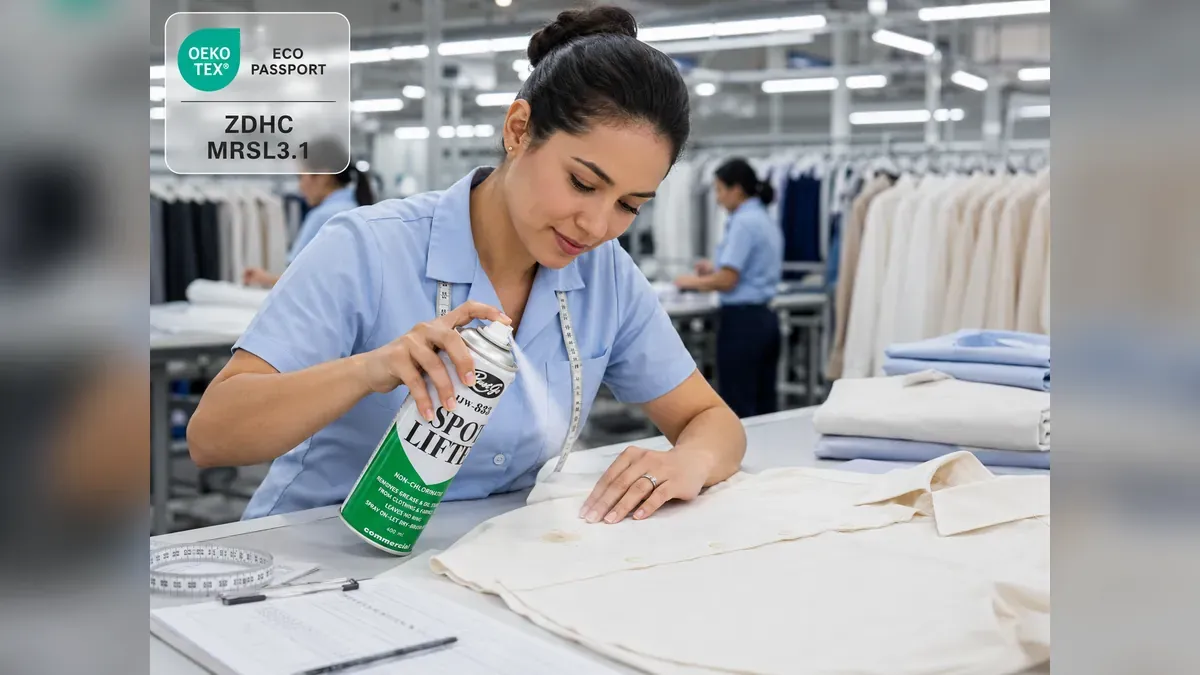
JJW-833 Spot Lifter: Garment Factory Buyer’s Guide
JJW-833 Spot Lifter is one option in Huajie Chemical’s textile-care range for localized grease, oil, food, grass, water-mark, and cleaning-ring problems. Its main point of difference is straightforward: Huajie describes the formula as free from chlorinated solvents.
That description may put the product on a buyer’s shortlist, but it does not finish the approval process. A garment factory still needs to see how the spray behaves on its fabrics, dyes, finishes, and common production stains. Distributors also need to check which documents support the product claims they intend to place on a label or sales sheet.
This guide focuses on evaluating JJW-833 as a specific SKU. For a broader category-level selection method, read our fabric spot lifter guide for garment factories.
Where JJW-833 fits in garment production
Finished garments can pick up small marks at the sewing station, inspection table, sample room, pressing area, or packing bench. Rewashing the whole piece may be slow or unsuitable. A spot lifter lets the operator work on the marked area instead.
The JJW-833 product page lists grease, oil, grass stains, food spots, oily residue, water marks, and cleaning rings among its intended targets. It also lists wool, cotton, silk, corduroy, Dacron, nylon, Orlon, and other synthetic fabrics.
Those lists are useful for screening. They are not a blanket guarantee for every dyed or finished version of those materials. A black coated nylon, for example, presents a different risk from an undyed nylon swatch. Treat the stated compatibility as the beginning of a trial, not the result of one.
What “chlorinated-solvent-free” should mean to a buyer
Formula language can affect retailer requirements, factory chemical-management reviews, and private-label positioning. If the absence of chlorinated solvents matters to your program, ask Huajie to confirm the current formula status in writing and provide the corresponding specification or declaration.
Keep the claim narrow. It describes one aspect of the formula; it does not automatically prove fabric safety, worker exposure limits, transport status, or compliance in every market. Those questions require their own documents.
A useful approval pack may include the current safety data sheet, product specification, application directions, transport information, and any restricted-substance or test report that applies to JJW-833. Check the SKU name, issue date, test scope, and issuing organization on every report. Company-level credentials and product-level evidence serve different purposes.
Build a trial around actual factory defects
Do not test JJW-833 on a single clean swatch with a convenient stain. Use the defects that are costing the line time or causing rejects.
Prepare samples from current production and apply controlled amounts of the factory’s common contaminants. Include at least one fresh stain and one aged stain where that reflects the real workflow. Keep an untreated control next to each test area.
Record the following:
- stain removal after one treatment and after any permitted repeat treatment;
- drying time under normal ventilation;
- color change, gloss, texture, coating, or print disturbance;
- powder, film, odor, ring, or boundary left after drying;
- brushing, blotting, or wiping effort;
- variation between operators;
- average product used per successful treatment.
The last point matters in purchasing. Price per can says little if operators need repeated applications or if the treated area creates a second defect.
Pay special attention to delicate and dark fabrics
Silk, wool, dark shades, prints, coatings, and specialty finishes deserve a separate test group. Use offcuts from the approved production lot whenever possible. A hidden-area check on the finished garment is sensible, but it should not replace pre-production compatibility work.
Inspect the samples under the same lighting used by quality control. A ring or change in sheen that disappears under warm factory lighting may remain obvious in daylight or retail lighting. Let the area dry fully before judging it.
If the garment will later be pressed, washed, or treated with another finishing chemical, run the complete downstream process on the trial sample. Compatibility problems sometimes appear only after heat or a second chemical step.
Turn the approved method into an operator instruction
The product page recommends inspecting the stain, testing a hidden area, applying to the spot, allowing the formula to act, then brushing, blotting, or otherwise removing the lifted residue according to the fabric.
Factories should convert that general sequence into a short instruction for each approved fabric group. State the application distance, amount, dwell time, removal method, repeat limit, ventilation requirement, and rejection criteria. Add photographs of acceptable and unacceptable results if operators work across several shifts.
Do not ask operators to improvise with an unknown stain. Ink, adhesive, paint, and machine oil may need different products or procedures. Huajie’s textile range includes a dedicated I-SPRAY Ink Remover as well as several spot-lifter variants. A smaller number of clearly assigned products is easier to control than one can used for every mark.
Questions for wholesale and private-label orders
Once the formula passes the fabric trial, review the supply program. Ask about available fill sizes, aerosol components, spray pattern, carton configuration, minimum order quantity, lead time, and sample process. For private-label work, confirm artwork responsibility, label languages, warnings, barcodes, batch coding, and change control.
Request a retained sample from the approved batch and agree on the checks used for later production. Spray pattern, discharge behavior, appearance, and cleaning result should stay consistent along with the can artwork.
When JJW-833 belongs on the shortlist
JJW-833 is worth testing when a garment or textile-care program needs localized treatment for the listed stains and prefers a chlorinated-solvent-free option. Approval should depend on the result on the buyer’s own materials and process, supported by current SKU-level documents.
To discuss a trial, contact Huajie Chemical with the fabric types, stain list, destination market, order estimate, and packaging requirements. A specific application brief will produce a more useful sample recommendation than a request for the “strongest” formula.
FAQ
What stains is JJW-833 intended to remove?
Huajie lists grease, oil, grass stains, food spots, oily residue, water marks, and cleaning rings. Results should be checked on the factory’s own stains and fabric lots.
Can JJW-833 be used on silk or wool?
Silk and wool appear in the product’s stated fabric range. Because dyes and finishes vary, test an offcut or discreet area and inspect it after full drying before approval.
Does chlorinated-solvent-free mean the product meets every buyer standard?
No. It is a formula characteristic, not a substitute for the safety data sheet, restricted-substance documents, market labeling review, transport information, or product testing.
Should a factory use one spot lifter for every stain?
Usually not. Group products by approved stain and fabric use. Ink, adhesive, paint, grease, and cleaning rings may call for different treatment methods.
What should be included in a sample request?
Send the stain types, fabrics and finishes, current cleaning method, destination market, preferred package, estimated volume, and any customer chemical requirements.