Jul 23, 2026Buying Guides
Fabric Spot Lifter Guide for Garment Factories
Learn how garment factories and textile buyers can compare fabric spot lifters by stain type, fabric compatibility, workflow, formula, and B2B supply support.
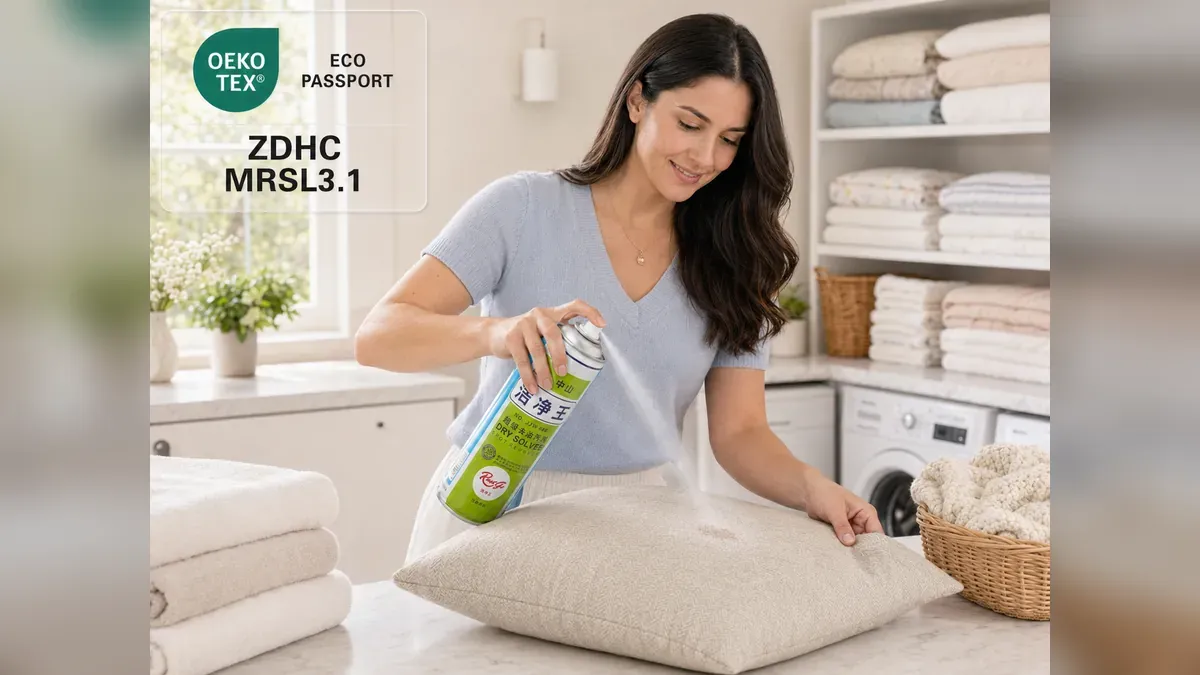
A spot lifter used in a garment factory has little room for error. The operator may be treating a finished shirt minutes before packing, a sample that cannot be washed again, or a delicate fabric where a cleaning ring creates more rework than the original stain.
Product names reveal very little about factory performance. Buyers need to compare formulas against the stains they actually see, the fabrics in production, the way operators work, and the documents required for the destination market.
This guide covers that selection process for garment factories, textile finishers, distributors, and private-label buyers. For a short introduction to the product category, see What Is a Fabric Spot Lifter and When Should You Use One?.
Start with the stains that actually cause rework
Start with production records. A request for a “strong stain remover” is too vague to guide a useful product trial. List the marks that repeatedly delay inspection or packing instead.
Common garment-production problems include:
- sewing-machine oil and industrial grease;
- food or handling marks from sampling and packing areas;
- pen ink and marker residue;
- water marks and cleaning rings;
- adhesive or oily residues from production;
- localized soil on collars, cuffs, seams, and finished panels.
Light oil and ink rarely respond the same way. A formula may remove one cleanly but leave the other behind, and aggressive treatment can produce a visible edge on dyed or finished fabric. Give the supplier real stain samples or a ranked stain list before asking for a recommendation.
Huajie's Textile Solutions category includes several spot lifters, a dedicated ink remover, ironing spray starches, and silicone sprays. A factory dealing with several recurring problems may get better results from two clearly assigned products than from one multipurpose can.
Match the product to the fabric mix
One facility may process cotton, polyester, blends, wool, nylon, silk, corduroy, and coated materials. Color loss is only one possible failure. Treatment can also change the hand feel, gloss, surface texture, print, coating, or appearance of the cleaned area.
Test on material from current production before approval. Include dark and pale colors, delicate surfaces, prints, coatings, and fabrics used for export programs with strict chemical requirements.
A practical test should answer four questions:
- Does the product remove the target stain at the expected dosage?
- Does the cleaned area blend into the surrounding fabric after drying?
- Does the treatment affect color, texture, print, coating, or finish?
- Can operators repeat the result under normal line conditions?
The JJW-833 Spot Lifter product page lists wool, cotton, silk, corduroy, Dacron, nylon, Orlon, and other synthetic fabrics. Treat that list as a starting point, not a substitute for testing. Dye systems and finishes vary between garment programs.
Evaluate the complete treatment workflow
Removal strength alone does not determine line performance. The product also has to fit the operator's available time, workspace, equipment, and training.
During a trial, record:
- application distance and spray control;
- wetting area and risk of overspray;
- time required before brushing, blotting, or wiping;
- residue after the treated area dries;
- ring formation or visible boundaries;
- odor and ventilation requirements;
- number of treatments needed for common stains;
- average cans used per production volume.
A formula can perform well on a laboratory swatch and still be awkward on the line. Overspray, repeated treatment, or visible residue on dark fabric can erase any gain in cleaning strength. Have operators compare shortlisted products under the same conditions: identical fabric, stain amount, treatment time, and inspection standard.
Review formula and compliance information carefully
Export buyers often review formulation and chemical-management information as part of approval. Check it at SKU level.
Huajie describes JJW-833 as chlorinated-solvent-free. The company website also shows OEKO-TEX Eco-Passport, ZDHC MRSL 3.1, and SGS references. Ask for the report itself, its scope and issue date, and confirmation that it covers the SKU under review. A company-level certificate or a report for another formula is not product-level evidence.
Request the documents relevant to your market and application, such as:
- the current safety data sheet;
- product specification and application instructions;
- ingredient or restricted-substance declarations required by the buyer;
- relevant test reports and their covered SKU;
- label and transport information for the destination market;
- batch identification and quality-control records.
This check gives the factory and distributor the same written basis for approval and keeps unsupported claims out of labels and sales material.
Compare the product range, not only one SKU
A factory or distributor may need more than one treatment product:
- JJW-833 Spot Lifter is positioned as a chlorinated-solvent-free stain-removal option for premium textile care.
- I-SPRAY JJW-836, JJW-668, JJW-880, JJW-832, JJW-830, and JJW-831 provide additional spot-lifter choices within the textile category.
- I-SPRAY Ink Remover is positioned for newly dyed pen inks, marker resins, and handwriting stains before washing.
- Ironing spray starches can support finishing rather than stain removal.
- Silicone sprays can support sewing-machine lubrication and surface protection.
Ask what each formula is meant to remove and where its limits are. A short, well-defined trial set is easier to train around and reorder than a long list of products with overlapping claims.
What private-label and wholesale buyers should confirm
Distributors and private-label brands also need to evaluate the package and supply program.
Confirm the following before placing an order:
- available can sizes, valves, actuators, caps, and carton configurations;
- spray pattern and discharge rate for the intended use;
- formula-to-package compatibility and stability testing;
- artwork, label language, warnings, and barcode requirements;
- sample and pilot-order process;
- minimum order quantity and production lead time;
- batch traceability and incoming quality checks;
- transport classification and export documentation;
- change-control procedure if a component or raw material changes.
When the buyer's name goes on the can, an impressive first sample is not enough. The approved formula, spray performance, package, and documentation must be repeatable from batch to batch.
A simple factory evaluation scorecard
Record the trial results in a scorecard. General impressions are hard to compare after several products and fabrics have been tested.
Evaluation area | What to measure |
|---|---|
Stain removal | Result on the factory's five most common stains |
Fabric safety | Color, texture, print, coating, and ring formation |
Workflow fit | Treatment time, overspray, brushing or wiping effort |
Operator consistency | Variation between trained users and shifts |
Documentation | SDS, specification, test scope, labeling, transport papers |
Supply fit | Packaging options, MOQ, lead time, batch consistency |
Commercial fit | Cost per successful treatment, not only price per can |
Compare cost per successful treatment, not price per can. Repeated application and avoidable rejects can make the cheaper product more expensive on each finished garment.
Final recommendation
Approve a spot lifter only after it removes the target stains without unacceptable fabric changes, works consistently in the hands of line operators, and comes with the required documents. The supplier should also be able to reproduce the approved formula and package in later batches.
To request a suitable trial set from Huajie Chemical, send a short application brief with the main stains, fabric types, target market, estimated order volume, and packaging requirements.
FAQ
What is the best fabric spot lifter for a garment factory?
There is no universal best formula. Compare products on the factory's common stains and fabrics, then check treatment time, operator consistency, documentation, and cost per successful treatment.
Should a factory test every fabric before use?
Test representative fabrics during product approval, then run a discreet-area check whenever a new or high-risk material enters production. Pay particular attention to dark dyes, silk, prints, coatings, and delicate finishes.
Is a chlorinated-solvent-free spot lifter available?
Huajie describes JJW-833 as chlorinated-solvent-free. Request the current specification and confirm which supporting documents apply to that product and destination market.
Can a spot lifter remove ink?
Some spot lifters can help with certain ink marks, but ink often needs a dedicated product. Huajie's textile range includes I-SPRAY Ink Remover for pen ink, marker resin, and handwriting stains.
What information should I send when requesting samples?
Send the fabric and stain types, current cleaning method, destination market, estimated order size, required packaging, and applicable chemical standards. Photos or stained fabric samples make the trial recommendation more useful.