Jul 28, 2026Buying Guides
Engine Cleaner: Degreasing Guide for Automotive Buyers
A B2B engine cleaner guide covering soil definition, material compatibility, controlled application, residue, packaging, and supplier sample tests.
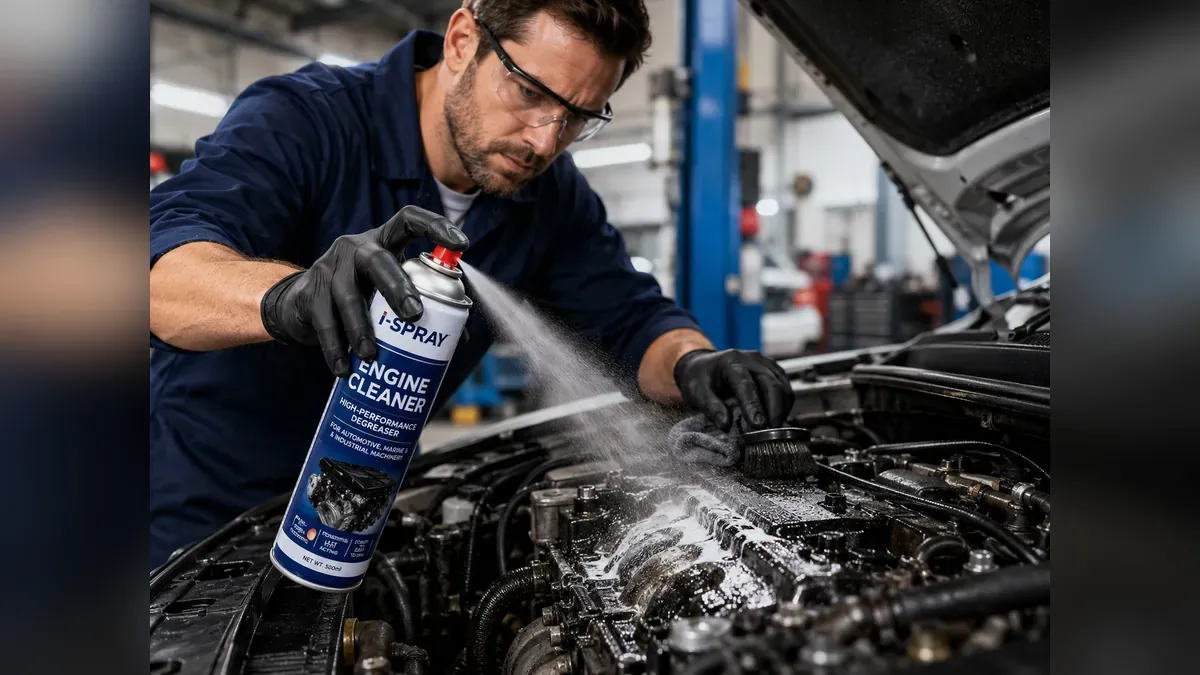
An automotive engine cleaner should be selected for a defined contaminant, surface, and cleaning procedure. "Removes grease" is too broad for supplier approval because an engine bay can contain painted metal, bare metal, plastics, rubber, wiring, labels, sensors, and electrical connections.
The buyer's first task is to narrow the job. Is the product intended for removed metal components, accessible exterior engine surfaces, heavy machinery, marine equipment, or a consumer engine-bay routine? Each use case changes the compatibility and application requirements.
This guide shows distributors and workshop suppliers how to evaluate engine cleaner without relying on a one-spray demonstration.
Define the cleaning job
Huajie's I-SPRAY Engine Cleaner is positioned as a degreaser for automotive, marine, tractor, and industrial machinery applications.
That broad range should be translated into specific test panels and parts. List the soils customers actually encounter, such as fresh oil, aged grease, road dirt, dust bound with lubricant, and maintenance residue.
Do not combine all contamination into one undefined "dirty engine" test. A product may work well on fresh oil but need a different procedure for older buildup.
Map the surfaces before testing
An engine area is not one material. Build a surface list for the target vehicles or equipment:
- painted and coated metals;
- aluminum and steel components;
- rigid and flexible plastics;
- rubber hoses and seals;
- cable insulation;
- printed labels and markings;
- connectors, sensors, and electrical parts;
- adjacent body paint and trim.
Then obtain the approved product scope and exclusions. A cleaner suitable for a removed metal part may not be appropriate for spraying over an assembled engine bay.
Use a small-area compatibility check where the instructions allow, but do not treat one short test as proof for every material or contact time.
Cleaning performance should be repeatable
Prepare a written comparison method.
- Select representative panels or components.
- Apply a measured and defined soil.
- Allow the soil to age for a consistent period if relevant.
- Apply a controlled amount of cleaner.
- Record dwell time, agitation, wiping, or rinsing.
- Inspect soil removal and remaining film.
- Check the material again after it has dried.
- Repeat with several samples.
Record the amount of product and labor needed. A cleaner that removes soil only after repeated heavy spraying may not be economical even if the final panel looks clean.
Spray pattern, dwell, and removal
A broad spray can cover open areas, while a focused spray may suit individual components. Evaluate the actuator and any extension tube in the real access conditions.
Watch for excessive mist, bounce-back, runs, and pooling. The operator should be able to control where the cleaner goes, especially near excluded components.
The supplier instructions should explain what happens after spraying. Does the approved method require wiping, brushing, rinsing, or air drying? Buyers should not invent a removal step because the draft label is incomplete.
Residue matters. Inspect surface feel, visible film, odor, and any effect on later maintenance or coating steps.
Electrical and hot-surface precautions
Engine cleaning can involve electrical components and surfaces that become hot. The final label and workshop procedure should state shutdown, cooling, isolation, ventilation, and excluded areas as applicable to the supplied product.
Do not market an aerosol cleaner as universally safe on electronics unless the exact product has been approved for that job. Huajie lists a separate JJW-789 Precision Contact Cleaner for electrical-contact cleaning applications.
Job-specific products make the range easier to understand and reduce cross-use mistakes.
How engine cleaner differs from brake and carburetor cleaner
Engine cleaner, brake cleaner, and carburetor cleaner may all remove oil or grease, but their intended components and application conditions differ.
The existing Brake Cleaner vs Carburetor Cleaner guide explains why braking-system and intake-system products should not be treated as interchangeable. The same logic applies to engine cleaner.
Use engine cleaner only within its confirmed scope. Do not turn a list of related aerosol cleaners into a universal-solvent claim.
Packaging and documentation review
Inspect the can, valve, actuator, cap, extension tube if supplied, batch code, label, and carton. Test spray performance at practical angles and after repeated use.
Request:
- current product specification;
- safety data sheet;
- transport information;
- label and warning copy;
- approved application and material list;
- packaging specification;
- batch and production-control information.
For a private-label project, agree on cleaning claims and exclusions before artwork approval. Product photography and bold words such as "heavy duty" do not define the test behind the claim.
Questions to ask a supplier
Use these questions during sample review:
- Which contaminants and components were used in testing?
- Which materials are approved and excluded?
- Is the product intended for assembled engine bays, removed components, or both?
- What dwell, wiping, brushing, or rinsing procedure applies?
- What residue should the user expect?
- How should electrical parts, sensors, belts, hot surfaces, and paint be protected?
- How are valve output, fill weight, leakage, and batch consistency checked?
- Which package and private-label options can be confirmed?
Ask for written answers tied to the exact sample.
Final recommendation
Select automotive engine cleaner around a narrow, testable job. Define the soil, material, application method, excluded areas, and acceptable residue. Compare several cans using the same panels and procedure.
For samples or private-label supply, contact Huajie Chemical with the target components, typical contamination, cleaning procedure, market, package requirement, and document list.
FAQ
Can engine cleaner be sprayed over every engine-bay component?
No. Engine bays contain many materials and sensitive parts. Follow the exact approved scope and protect or exclude electrical components, sensors, belts, paint, and other listed areas.
Is engine cleaner the same as brake cleaner?
No. The products are positioned for different jobs. Brake cleaner is intended for approved braking-system parts, while engine cleaner is evaluated for defined engine and machinery degreasing applications.
Should the engine be hot during cleaning?
Follow the product and equipment instructions. Aerosol cleaners should not be applied to hot or energized equipment unless the exact procedure explicitly permits it.
What should importers test first?
Test the target soil on representative materials. Record product amount, dwell, cleaning steps, residue, material appearance, spray control, and results across several cans.
Can the actuator or extension tube be customized?
Options must be confirmed with the supplier. Any change should be tested because the spray pattern affects coverage, access, overspray, and product use.