Jul 23, 2026Buying Guides
Brake Cleaner vs Carburetor Cleaner: B2B Guide
Compare brake cleaner and carburetor cleaner by application, soil, compatibility, evaporation, testing, and private-label sourcing requirements.
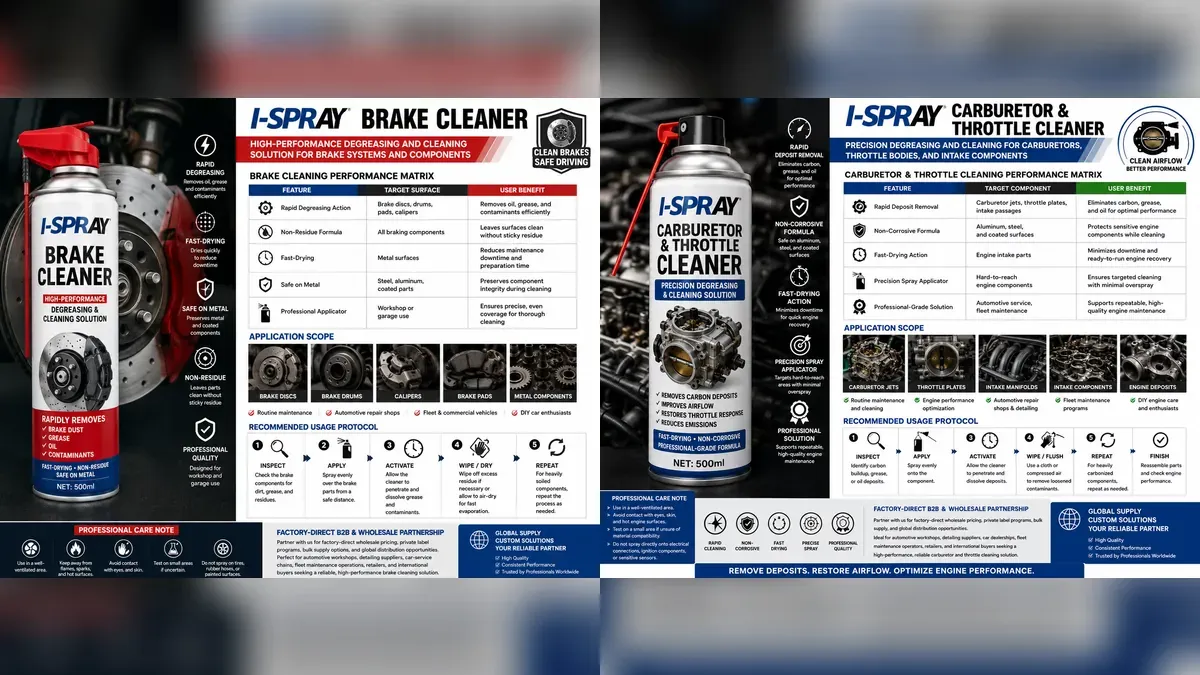
Brake cleaner and carburetor cleaner often sit next to each other on the shelf, but they are made for different maintenance jobs. Treating them as interchangeable can produce poor cleaning results, damage sensitive materials, and leave distributors with a range that is hard to explain.
“Which one is stronger?” is the wrong starting point. Buyers need to match the formula, spray pattern, and drying behavior to a specific component and contaminant.
The comparison below covers the checks importers, workshop suppliers, and private-label buyers should make before ordering.
The short answer
Brake cleaner is intended for braking-system components and removes grease, oil, dirt, and service residue from parts such as discs, drums, and calipers.
Carburetor and throttle cleaner is intended for fuel-and-air intake components, including carburetor jets, throttle plates, and intake areas affected by oil, grease, or carbon-like deposits.
Both products degrease, but buyers should assess their approved materials, residue, spray behavior, and label instructions separately.
Brake cleaner: designed around braking components
- brake discs and drums;
- calipers and related metal components;
- braking-system parts requiring grease and contaminant removal;
- routine brake maintenance and inspection;
- automotive repair shops, detailing centers, and fleet service.
During testing, check how quickly it removes service contamination, how well the spray can be controlled, how it dries, and whether it leaves residue on the approved component.
Brake-system work affects vehicle safety. Follow the product label, workshop procedure, and component manufacturer's instructions. Ventilation, personal protection, and local chemical rules also apply.
Carburetor cleaner: designed around intake deposits
Huajie's I-SPRAY Carburetor & Throttle Cleaner is listed for carburetors, throttle bodies, and intake components, including:
- carburetor jets and throttle plates;
- intake manifolds and related parts;
- components exposed to oil, grease, or deposits;
- aluminum, steel, and certain coated intake-system parts;
- routine carburetor and throttle-body cleaning.
These parts have narrow passages and detailed surfaces. The spray must reach the deposit and work with the user's method for wiping, flushing, or removing loosened material.
Check compatibility before approval. Modern intake assemblies may contain coatings, plastics, seals, sensors, and electronics that cannot tolerate every solvent cleaner.
Brake cleaner vs carburetor cleaner comparison
Buying question | Brake cleaner | Carburetor & throttle cleaner |
|---|---|---|
Primary job | Remove grease and service contamination from approved brake components | Remove oil, grease, and deposits from approved intake components |
Typical parts | Discs, drums, calipers, metal brake parts | Carburetor jets, throttle plates, intake manifolds |
Main performance focus | Degreasing, controlled application, drying, low unwanted residue | Deposit penetration, detailed component access, removal of loosened contamination |
Key compatibility risk | Paint, plastics, rubber, coatings, and non-approved friction components | Sensors, seals, plastics, coatings, and electronic assemblies |
User environment | Workshop, fleet service, repair, automotive retail | Workshop, engine service, repair, powersports or small-engine channels |
B2B validation | Component tests, residue review, spray output, label and SDS | Deposit tests, substrate compatibility, spray access, label and SDS |
The table is a purchasing comparison, not a use instruction. The final specification and label define where each product can be applied.
Why one universal cleaner is rarely the best commercial answer
A universal cleaner is easy to advertise and difficult to validate. It puts more material and component checks on the supplier and more judgment on the workshop. Separate products are usually easier to sell and use correctly:
- the brake cleaner has a clear braking-system position;
- the carburetor cleaner has a clear intake-cleaning position;
- packaging colors and icons can reduce selection mistakes;
- distributors can train sales staff around applications rather than chemistry;
- product pages can target distinct search questions without competing for the same keyword.
If one formula will cover several jobs, require a documented scope for the destination market. Informal cross-use advice is not enough.
Seven questions to ask an automotive aerosol supplier
1. What exact contaminants was the formula tested against?
Ask whether the test soil represents workshop grease, oil, brake-fluid residue, road contamination, varnish-like deposits, or carbon-related buildup. “Powerful cleaning” says nothing about the test.
2. Which materials are approved and excluded?
Build a substrate list that covers the actual components used by customers. Include metals, common coatings, plastics, rubber, seals, and painted surfaces where relevant.
3. What spray pattern and extension tube are available?
A broad spray can suit open components, while a focused jet or extension tube can improve access and reduce waste. Evaluate actuator feel, output consistency, and leakage after storage.
4. What remains after drying?
Review visible film, odor, surface feel, and the need for wiping. Use a consistent panel and inspection procedure during comparison tests.
5. What documents support the product?
Request the current specification, safety data sheet, label text, transport information, batch identification, and any market-specific declarations required by the importer.
6. How is production consistency controlled?
Ask how fill weight, valve performance, leakage, spray output, and batch release are checked. For private-label business, agree on acceptance criteria before mass production.
7. What can be customized?
Confirm can size, actuator, cap, carton, artwork, language, barcode, formula options, minimum order quantity, sampling, and production lead time. Do not assume every component can be changed without repeating compatibility or stability work.
A practical sample test for importers and distributors
Use real components and a written comparison sheet.
- Select representative brake and intake parts.
- Apply a controlled amount of defined contamination.
- Record spray distance, coverage, treatment time, and cleaning steps.
- Inspect cleaning result, residue, odor, and material appearance.
- Check the can, valve, cap, and actuator after repeated use and storage.
- Repeat across multiple samples or batches before approval.
- Keep photographs and results as part of the approved product file.
The test should show a repeatable result under the buyer's sales and service conditions. A dramatic one-can demonstration is less useful than consistent results across several samples.
Building a broader auto-care aerosol range
Brake and carburetor cleaners can anchor a wider range that includes battery terminal protector, chassis armor spray, bolt loosener, aerosol lubricant or spray grease, tire inflator and sealant, spray paint, and other products in Huajie's Auto Care category.
Organize a distributor range by job:
- clean: brake, carburetor, and component cleaners;
- loosen and lubricate: penetrating products, spray grease, silicone lubricant;
- protect: battery terminal and chassis products;
- repair and finish: tire inflator, sealant, coatings, and paint.
Clear job labels make packaging, staff training, and cross-selling easier without giving every can the same broad claim.
Final recommendation
Treat brake cleaner and carburetor cleaner as separate products. Before approval, define the component, contaminant, material, spray pattern, drying requirement, documentation, and package.
To discuss samples or a private-label range, send Huajie Chemical the target applications, destination market, estimated volume, and packaging brief.
FAQ
Are brake cleaner and carburetor cleaner the same?
No. Both may remove oil and grease, but brake cleaner is positioned for approved braking-system components, while carburetor cleaner is positioned for carburetors, throttle bodies, and intake parts.
Can brake cleaner be used on a throttle body?
Do not assume cross-use. Check the vehicle or component guidance and the exact product label. Coatings, plastics, seals, sensors, and electronics can change the compatibility risk.
What should private-label buyers test first?
Start with cleaning performance on defined contamination, substrate compatibility, drying and residue, spray output, valve reliability, packaging stability, and the completeness of the label and technical documents.
Can the actuator and can size be customized?
Customization may be available, but it must be confirmed with the supplier. Any change to the can, valve, actuator, or formula may require renewed compatibility and stability checks.
Which product is better for a workshop distributor?
Many workshop channels benefit from carrying both because the products address different jobs. The better range is the one with clear application boundaries, reliable documentation, repeatable quality, and packaging that prevents selection mistakes.