Jul 28, 2026Buying Guides
Chrome Spray: Decorative Metal Finish Selection Guide
Select chrome spray for decorative metal finishes by substrate preparation, color approval, application control, topcoat testing, durability, and supply.
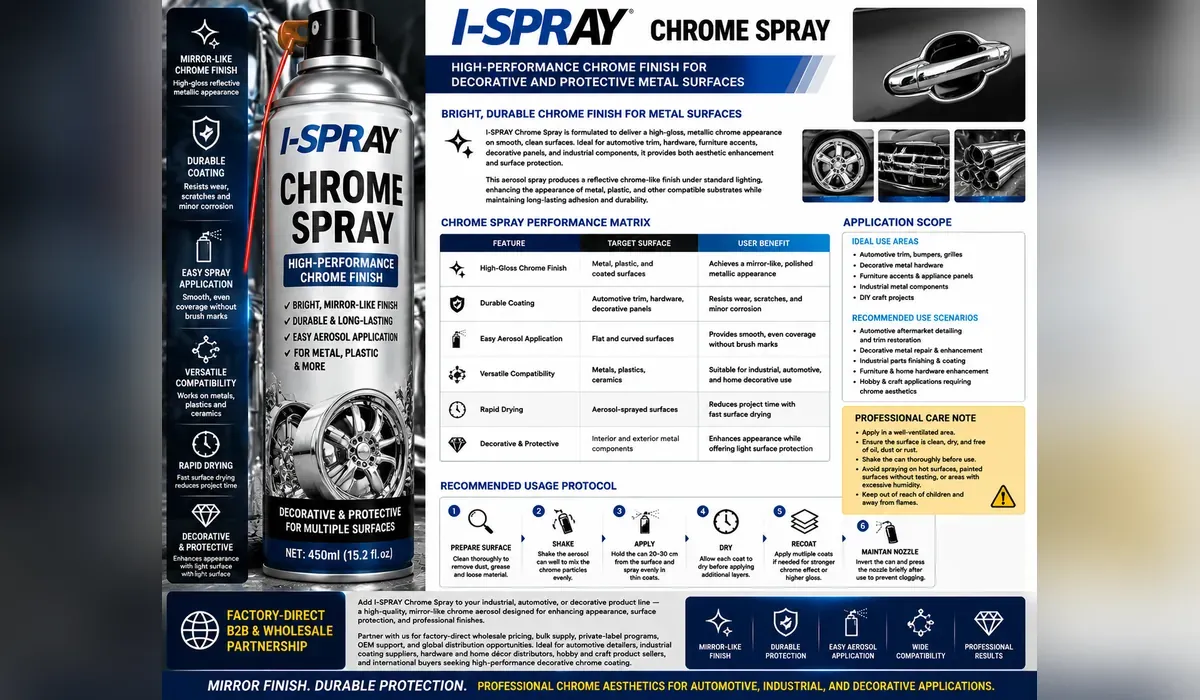
Chrome spray for metal is primarily a decorative coating choice. Buyers should approve it against a prepared substrate, desired metallic appearance, handling conditions, application method, and any required topcoat or maintenance process.
It should not be presented as electroplating or selected as a corrosion-repair coating merely because the finish looks metallic. Appearance, protection, and process compatibility are separate questions.
Define the intended finish
- metal, wood, plastic, previously painted surface, or another approved substrate;
- indoor display, decorative hardware, craft, repair, prop, trim, or project use;
- smooth mirror-like, bright metallic, silver, or another appearance expectation;
- viewing distance and lighting;
- size and geometry of the part;
- touch, abrasion, cleaning, weather, and heat exposure;
- need for primer or sealer;
- whether a clear coat will be used;
- target drying and handling schedule;
- color reference and acceptable variation.
The word “chrome” is interpreted differently across markets. Approve a physical sample, not a screen image or cap color.
Decorative spray is not chrome plating
Electroplated chrome and aerosol metallic paint use different processes and produce different surfaces. Marketing and distributor training should state the product format clearly.
If a customer requires plating-level hardness, reflectivity, chemical resistance, or a regulated finish, an aerosol decorative coating should not be substituted without qualification.
Substrate preparation controls appearance
Reflective or bright metallic finishes reveal scratches, dust, sanding marks, and uneven primer. A smooth, stable base is important.
Build the test method around the product instructions and record:
- removal of oil, wax, corrosion, and loose coating;
- sanding or abrasion grade;
- dust removal;
- primer type and cure;
- surface color and gloss;
- temperature and humidity;
- time between preparation and coating.
Two cans cannot be compared fairly on different base coats. If the target includes several substrates, create a panel for each.
Test old coatings before full application
Solvents in a new coating can lift, wrinkle, soften, or bleed an existing finish. Apply a small compatibility area and wait through the stated drying period.
When the old coating is unknown, removal and rebuilding the finish may be more reliable than overcoating. The project method should decide this before production.
Control the spray technique
Metallic appearance is sensitive to distance, speed, overlap, coat thickness, orientation, and drying interval. Too much wet paint can sag or change the way metallic particles align; too little can look patchy.
During sample approval, evaluate:
- fan width and atomization;
- start and stop control;
- edge and recess coverage;
- overspray;
- tendency to spit or clog;
- consistency on vertical and horizontal surfaces;
- appearance after each recommended coat;
- amount used per acceptable part.
Use the same trained operator or a controlled fixture for comparisons. Record the procedure so a good panel can be reproduced.
Approve appearance after full drying
Inspect under lighting representative of the sales or service environment. Review:
- brightness and metallic character;
- uniformity across the panel;
- stripes, clouds, dry spray, or mottling;
- visible scratches or substrate defects;
- edge coverage;
- color shift at different angles;
- fingerprints or marks after the approved handling time.
Keep a signed reference panel from the approved batch or pilot. It gives the buyer and supplier a better visual standard than the phrase “bright chrome.”
Be careful with clear coats
A clear coat can change brightness, color, reflectivity, and texture. It can also affect adhesion or cause lifting if systems are incompatible.
If a clear finish is required for handling or exposure, test the exact base coat, interval, clear product, number of coats, and curing process. Approve the final system rather than the uncoated sample.
Separate appearance from durability
A visually bright coating may be intended for decorative indoor use, while an exposed outdoor part needs a more demanding protective system.
Define and test the relevant conditions:
- repeated handling;
- abrasion or rubbing;
- cleaning chemicals;
- water and humidity;
- sunlight and weather;
- heat;
- contact with plasticizers, oils, or packaging.
Ask for evidence tied to the exact product and conditions. Do not create a service-life claim from a short demonstration.
For localized metal protection, a galvanizing spray has a different selection purpose. For layout lines, use a marking product. Similar metallic or colored cans do not make their films interchangeable.
Plan a representative product trial
Use real parts after initial panel screening. Complex shapes reveal edge coverage, shadowing, access, and overspray.
Record:
- substrate and preparation;
- primer or base coat;
- ambient conditions;
- spray distance, passes, and intervals;
- drying and handling times;
- appearance under defined lighting;
- topcoat process if used;
- adhesion, handling, and exposure checks;
- consumption and reject reasons.
The accepted method should be practical for the intended user. A finish requiring specialist technique may need clearer instructions or a different channel position.
Documentation and private-label sourcing
Request the current SDS, product specification, approved substrates, preparation and application instructions, drying guidance, storage and transport information, batch coding, and evidence supporting any durability claim.
Private-label buyers should align:
- approved color and reference panel;
- formula and coating system;
- can size and fill quantity;
- valve, actuator, cap, and carton;
- label directions, warnings, and languages;
- sample, pilot, and artwork approval;
- color, appearance, leakage, spray-output, and fill checks;
- batch traceability and retention;
- change-control and complaint process;
- MOQ, lead time, and reorder plan.
Color and actuator changes can alter the user’s result, so they should not be treated as minor purchasing substitutions.
Huajie’s industrial maintenance aerosol guide explains how to separate decorative coatings from repair coatings and other MRO products.
Final recommendation
Choose chrome spray by an approved physical finish and reproducible coating process. Prepare the substrate carefully, test the exact topcoat system, match durability to the exposure, and describe the result as an aerosol decorative coating rather than plating.
To discuss samples and private-label options, contact Huajie Chemical with the substrate, desired finish, exposure, market, package, and estimated volume.
FAQ
Is chrome spray the same as chrome plating?
No. Chrome spray is an applied decorative coating, while chrome plating is a different finishing process. Appearance and durability should be approved for the intended use.
Why does a chrome-effect finish look uneven?
Substrate scratches, base-coat variation, dust, spray distance, overlap, coat thickness, and drying conditions can affect the metallic appearance.
Can I apply a clear coat over chrome spray?
Only after testing the exact coating system. A clear coat can change brightness, color, texture, and adhesion.
Can chrome spray protect outdoor metal from corrosion?
Do not assume it is a corrosion-repair system. Define the exposure and use a coating with suitable instructions and evidence. Galvanizing spray has a different repair purpose.
What should private-label buyers approve?
Approve the reference panel, substrate preparation, formula, package hardware, application method, final coating system, documents, quality checks, traceability, MOQ, and lead time.