Jul 28, 2026Buying Guides
Battery Terminal Protector: Corrosion Prevention Guide
A B2B guide to evaluating battery terminal protector for corrosion control, workshop use, fleet maintenance, packaging, and private-label supply.
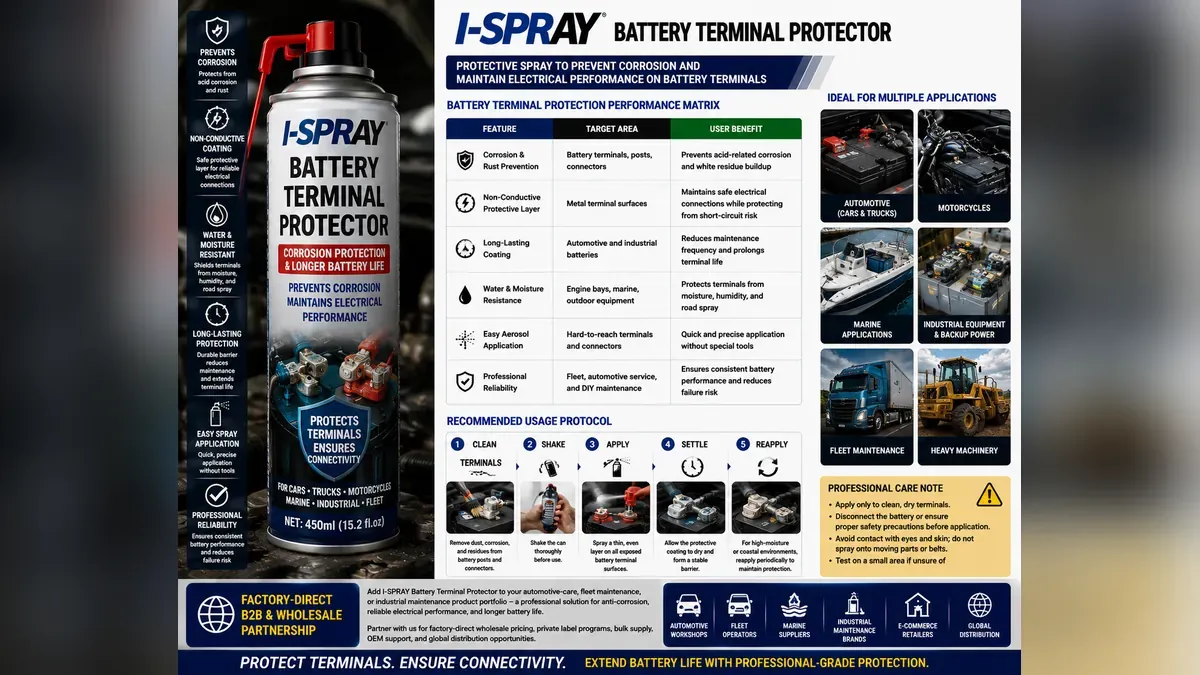
A battery terminal protector is applied after the terminal has been cleaned and the connection has been secured. Its job is to form a protective barrier over exposed terminal surfaces and help reduce corrosion caused by moisture and service conditions.
It does not clean a badly corroded terminal, repair a loose connection, or restore a failing battery. That is the first point buyers should make clear on the label and in sales training.
For importers, workshop suppliers, and fleet-maintenance buyers, the purchasing decision comes down to application control, coverage, compatibility, drying behavior, packaging, and repeatable protection under the conditions their customers face.
What the product is designed to do
Huajie's I-SPRAY Battery Terminal Protector is listed for corrosion and rust protection on battery terminals, posts, and connectors. Its stated application range includes cars, trucks, motorcycles, marine batteries, industrial equipment, heavy machinery, and backup-power systems.
The product page describes a thin, non-conductive protective layer intended for clean, dry terminal surfaces. Buyers should preserve that sequence in their own instructions: inspect, disconnect or isolate safely, clean, secure, then protect.
Putting a coating over existing dirt or corrosion can hide a maintenance problem rather than solve it.
Start with the customer and environment
A workshop product, fleet product, and marine-channel product may share the same basic purpose but face different conditions.
Workshop users value controlled spraying and a clear visual indication of coverage. Fleet managers care about consistent maintenance procedures and stock control. Marine or outdoor-equipment channels will focus on moisture exposure. Retail buyers need instructions that prevent the product from being sprayed onto the wrong parts.
Define the main channel before approving the actuator, label, can size, and carton. A broad list of possible users is not a substitute for a primary use case.
What to inspect during sample testing
Spray pattern and access
Battery posts and connectors can be surrounded by cables, brackets, covers, and nearby painted or plastic parts. Check whether the actuator provides controlled coverage without excessive overspray.
Test the can at several practical angles. Record sputtering, valve response, nozzle blockage, and leakage after repeated use. If an extension tube is offered, confirm that it stays attached and delivers a useful pattern.
Film coverage
Apply the product to a cleaned test terminal or representative metal panel. Look for missed areas, runs, pooling, and an unnecessarily heavy film. The target is consistent coverage according to the product instructions, not the thickest possible layer.
Record drying behavior and surface appearance. If the coating has a visible color, confirm that it helps inspection without staining surrounding materials.
Compatibility
The terminal is not the only surface near the spray. Include common cable insulation, connector covers, painted brackets, plastics, and rubber components in the compatibility plan where relevant.
Do not expand the approved material list based on a quick spot test. Compatibility should be confirmed for the exact supplied product and the expected contact conditions.
Corrosion protection needs a maintenance procedure
A battery terminal protector works best as one step in a defined service routine:
- Inspect the battery, case, terminals, cables, and hold-down hardware.
- Follow the applicable electrical and workshop safety procedure.
- Remove existing corrosion and contamination using the approved method.
- Make sure the surfaces are clean and dry.
- Secure the connection to the equipment or vehicle requirement.
- Apply a thin, even protective layer to the exposed terminal area.
- Allow the coating to settle or dry as directed.
- Record the service and inspect it at the next maintenance interval.
The aerosol should not be used to disguise a damaged cable, cracked case, leaking battery, or loose terminal.
Questions for fleet and workshop buyers
Fleet programs need repeatability. Ask whether the product can be applied using the same procedure across the battery types in the fleet. Check how technicians will identify treated terminals and when reinspection is required.
The workshop should also decide how partially used cans are stored and how technicians prevent contamination of the nozzle. If the product is sold to consumers, the label needs stronger guidance on electrical safety and excluded spray areas.
Do not invent a universal reapplication interval. Exposure to moisture, road spray, heat, cleaning, and handling varies. Use the product instructions and the fleet's inspection findings.
Documents and production controls
Before ordering, request the current specification, safety data sheet, transport information, label copy, batch-code format, and packaging specification.
Ask the manufacturer how it checks:
- fill weight;
- valve and actuator operation;
- can and seam leakage;
- spray output and pattern;
- appearance of the applied film;
- packaging condition after storage and transport;
- batch release and retained samples.
For private-label orders, agree on the acceptance criteria before printing cans or cartons. Artwork approval should include warnings, languages, product scope, and application sequence, not only brand colors.
Building a corrosion-control range
Battery terminal protector can sit beside I-SPRAY Chassis Armor Spray, which is positioned for underbody and exposed metal protection. The products should not share vague "anti-rust" copy that makes them sound interchangeable.
Battery terminal protector is for the exposed terminal and connector area. Chassis armor is for approved vehicle underbody and metal surfaces. Clear naming and separate application diagrams help distributors sell both products without creating cross-use confusion.
For a broader workshop range, buyers can also review the existing Brake Cleaner vs Carburetor Cleaner guide, which uses the same job-specific approach to product selection.
Eight checks before placing an order
Use this list during supplier review:
- Confirm the intended battery types and service channels.
- Review the approved surfaces and exclusions.
- Test application on clean, dry representative terminals.
- Inspect coverage, drying, overspray, and surrounding materials.
- Test valve and actuator performance across several cans.
- Review safety, transport, label, and batch documents.
- Confirm can, cap, carton, language, and artwork options.
- Agree on production and pre-shipment acceptance criteria.
Keep test photographs and written results with the approved sample. They are more useful during repeat orders than a general note saying the product was "good."
Final recommendation
Select a battery terminal protector as part of a maintenance system, not as a stand-alone promise. The connection must first be safe, clean, dry, and secure. Then the protector can provide controlled coverage over the exposed terminal area.
For wholesale or private-label discussions, contact Huajie Chemical with the target market, battery applications, sales channel, preferred packaging, and documentation requirements.
FAQ
Does battery terminal protector remove existing corrosion?
No. Existing corrosion and contamination should be removed using the approved maintenance method before the protector is applied.
Is the product applied before or after connecting the terminal?
Follow the exact label and equipment procedure. The product is generally positioned as protection for clean, dry, properly secured terminal surfaces, not as a substitute for making the connection correctly.
What should distributors test?
Test spray control, coverage, drying, overspray, material compatibility, valve performance, leakage, and packaging. Use several samples rather than one demonstration can.
How often should it be reapplied?
Do not set a universal interval without supporting instructions. Inspect the terminal during scheduled maintenance and follow the product guidance for the actual exposure conditions.
Can it be sold for marine and industrial batteries?
The Huajie product page lists marine, industrial, backup-power, and vehicle applications. The importer should still confirm the final label scope and destination-market requirements for the supplied product.