Jul 28, 2026Buying Guides
Tire Inflator and Sealant: Emergency Repair Buyer Guide
Learn how to evaluate tire inflator and sealant for roadside kits, retail ranges, and private-label supply without making unsupported repair claims.
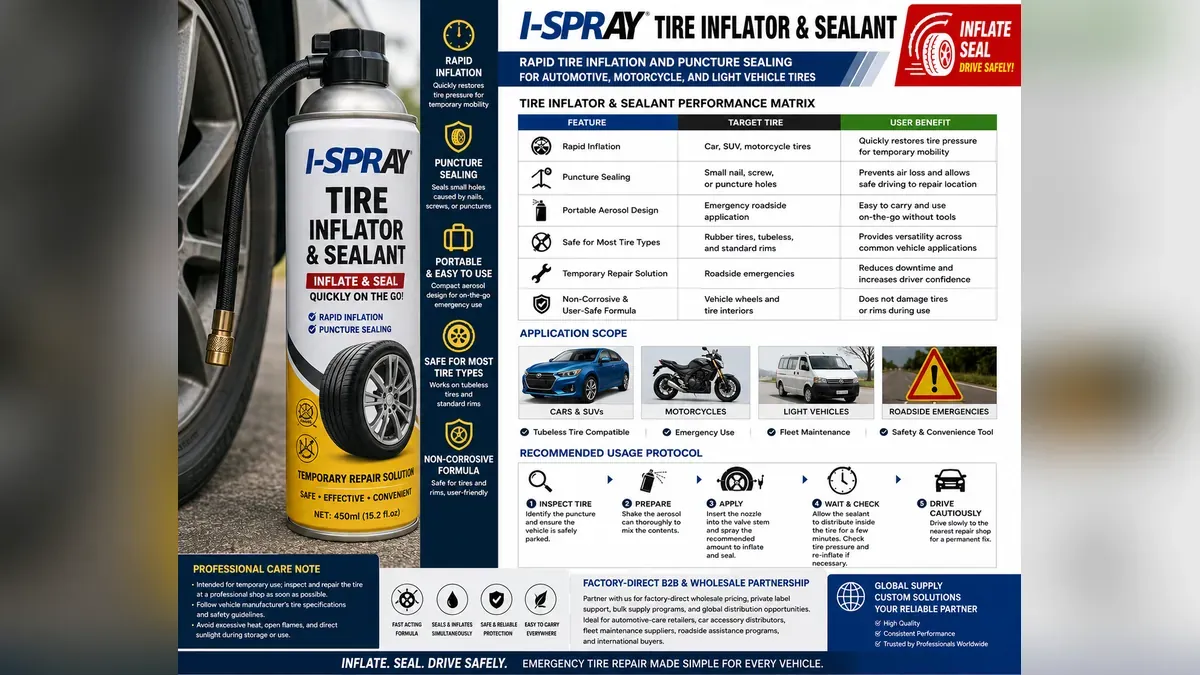
A tire inflator and sealant is an emergency mobility product, not a permanent tire repair. It is designed to help inflate and temporarily seal a suitable punctured tire so the driver can reach a safe place for inspection and proper service.
That distinction should shape the product, label, sales training, and sample test. Importers and distributors need more than a can that works in a demonstration. They need a product whose intended tire types, limitations, application steps, packaging, and documentation are clear enough for a stressed driver to understand at the roadside.
This guide explains what to check when adding an aerosol tire inflator and sealant to an automotive range.
Start with the emergency use case
Huajie's I-SPRAY Tire Inflator & Sealant is positioned for rapid inflation and puncture sealing for automotive, motorcycle, and light-vehicle tires.
The buyer should define the intended channel before discussing artwork or price. A product sold through petrol stations may need very simple front-label instructions. A roadside kit supplied with a vehicle may need different pack dimensions. Workshop and fleet channels will pay closer attention to storage, stock rotation, and the handover procedure after use.
The common requirement is clarity. Users must know that the product provides temporary assistance and that the tire still needs professional inspection.
Which puncture situations should be covered?
Do not approve broad claims such as "repairs every flat tire." A puncture in the tread area is different from damage to a sidewall, bead, valve, or wheel. A tire that has separated from the rim is also a different problem from a slow leak.
Ask the supplier to confirm the approved scope for the exact product and destination market. The label should identify exclusions without forcing the customer to interpret technical language at the roadside.
During sample review, include realistic failure cases:
- a small tread-area puncture within the stated product scope;
- a tire with low but measurable pressure;
- a completely deflated tire;
- sidewall or bead damage that the product must not claim to repair;
- a valve problem or visibly damaged wheel;
- tires and vehicle types common in the target market.
This testing is not a reason to expand the claim. It shows whether the claim is understandable and repeatable.
Evaluate inflation and sealing as separate jobs
A combined product has two tasks. It must deliver sealant into the tire and provide enough inflation for the approved emergency use. Buyers should record both results rather than giving one general pass or fail.
Inflation checks
Record the starting condition, application time, final pressure, ambient temperature, and whether the can discharged consistently. Do not publish a pressure or tire-size claim until it has been confirmed for the exact formula, can, valve, and test method.
Check how the hose or connector attaches to the valve. A connector that is difficult to fit can waste product and frustrate the user. Review leakage, hand clearance, operating angle, and the amount of force needed.
Sealing checks
Use a defined puncture and tire condition. After application, inspect whether the leak slows or stops within the product's stated scope. Follow the approved driving or distribution procedure, then recheck pressure.
The result should be documented across several samples. One successful demonstration is not enough for a purchasing decision.
Packaging matters at the roadside
The can, valve, hose, connector, cap, and printed instructions form one product. A good formula cannot compensate for a connector that leaks or an instruction panel that is unreadable in poor light.
Review these details during approval:
- hose length and storage;
- connector fit on the target valves;
- can grip with wet or gloved hands;
- cap retention during transport;
- instruction order and type size;
- warning visibility;
- batch code and shelf-life marking;
- carton protection for export and retail handling.
If the product will be included in a vehicle kit, check the full pack against the storage compartment. Heat exposure, vibration, and long periods without use also need to be considered in the agreed product specification.
Documentation and label questions
Tire inflator and sealant is an aerosol product used in a safety-related situation. The importer should request the current product specification, safety data sheet, transport information, batch identification method, and label copy.
Confirm which claims apply to the supplied formula and which statements are general marketing language. The destination market may have its own requirements for aerosol warnings, transport, language, recycling marks, and consumer instructions.
Ask who reviews translated labels. Roadside instructions should be written for a person using the product for the first time, not for a technician who already knows the procedure.
A practical sample approval method
Create a written test sheet before samples arrive.
- Define the tire type, size, starting pressure, puncture location, and puncture dimensions.
- Store samples under the test conditions agreed with the supplier.
- Record the connection process and any leakage.
- Measure discharge time and pressure after inflation.
- Follow the approved distribution or driving step.
- Recheck leakage and pressure at defined intervals.
- Inspect the valve, hose, can, and remaining product after use.
- Repeat with several cans and record batch numbers.
Use the same method when comparing suppliers. Changing the tire, puncture, or temperature between tests makes the results difficult to interpret.
Where it fits in an auto-care range
Tire inflator and sealant belongs in an emergency and maintenance range rather than a cosmetic detailing group. It can be paired with I-SPRAY Tire Foam Cleaner & Polish for routine tire appearance and with I-SPRAY Aerosol Lubricant / Spray Grease for general maintenance.
Keep the jobs separate in packaging and online navigation. Tire foam cleaner does not repair a puncture, and an emergency sealant should not be marketed as routine tire care.
For distributors, this separation makes staff training easier and reduces the risk of customers selecting the wrong can.
Questions to ask before ordering
Ask the supplier for written answers to the following:
- Which tire and vehicle types are within the approved scope?
- Which puncture locations and damage types are excluded?
- What sample test method supports the label claim?
- What can sizes, connectors, hoses, caps, and cartons are available?
- How are fill weight, leakage, valve function, and discharge checked?
- What documents will be supplied for the destination market?
- Which parts of the label can be customized?
- What storage and stock-rotation instructions apply?
Price should be compared only after these points are aligned. A lower unit cost can be misleading if the package, connector, or documentation does not fit the sales channel.
Final recommendation
Choose a tire inflator and sealant by testing the complete package in the intended emergency scenario. Define the approved tire types and punctures, make the temporary nature of the repair clear, and verify that the connector and instructions can be used without specialist knowledge.
To discuss samples or a private-label roadside range, contact Huajie Chemical with the destination market, target vehicle types, preferred can size, packaging brief, and expected sales channel.
FAQ
Is tire inflator and sealant a permanent repair?
No. It is intended as temporary emergency assistance. The tire should be inspected and properly repaired or replaced by a qualified service provider.
Can it repair sidewall damage?
Do not assume that it can. Sidewall, bead, valve, or wheel damage may be outside the product scope. Follow the exact label and tire-service guidance.
What should an importer test first?
Test the connector, inflation result, sealing result, instructions, can discharge, and leakage using a defined tire and puncture. Repeat the test across several samples.
Can the can and hose be customized?
Available options must be confirmed with the supplier. A change to the can, valve, hose, or connector can affect use and may require renewed testing.
What information should appear on the label?
The label should state the intended use, exclusions, application steps, warnings, temporary-repair message, storage instructions, batch identification, and any information required by the destination market.