Jul 28, 2026Buying Guides
Tire Foam Cleaner and Polish: Distributor Buying Guide
Evaluate tire foam cleaner and polish by cleaning, finish, compatibility, spray coverage, packaging, sample testing, and distributor requirements.
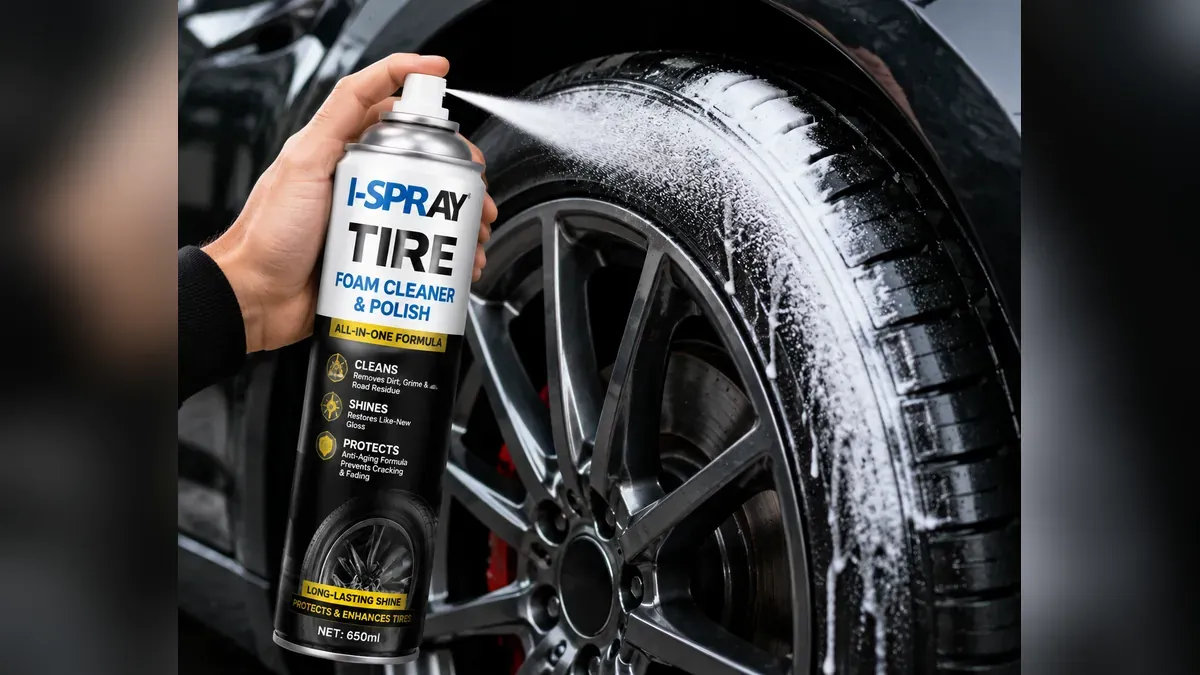
A tire foam cleaner and polish combines two visible jobs: removing everyday surface contamination and leaving an even finished appearance. Buyers should test those jobs separately.
A dramatic foam demonstration may look good on video, but it does not show whether the product cleans consistently, dries evenly, fits the target tire surface, or leaves overspray on the wheel and bodywork. For distributors and private-label brands, the full customer experience matters more than foam height.
This guide explains how to evaluate a tire foam product before adding it to a detailing range.
Define the intended finish
Huajie's I-SPRAY Tire Foam Cleaner & Polish is positioned as an all-in-one product for tire cleaning, shine, and protection.
Before comparing samples, decide what the customer should see after use. A retail customer may expect a visible shine, while a professional detailer may prefer a controlled finish that is easy to apply around different wheel designs.
Avoid vague approval notes such as "looks good." Create a reference for:
- cleaning result on defined road dirt;
- finish level after drying;
- uniformity around lettering and textured sidewalls;
- overspray and wipe-off from adjacent surfaces;
- surface feel;
- appearance after a defined inspection period.
The supplier cannot match an undefined finish target.
Separate cleaning performance from appearance
Cleaning and polishing are related but not identical. A product may leave a strong shine while covering residual dirt, or it may clean well but produce an uneven finish on a textured sidewall.
Prepare comparable tire sections with the same contamination. Record the starting condition and application amount. Inspect the surface before and after the product dries.
For a fair comparison, keep these factors consistent:
- tire type and sidewall condition;
- soil or road-film level;
- application distance;
- number and duration of spray passes;
- dwell time;
- wiping or no-wipe procedure;
- ambient conditions;
- inspection lighting.
Do not compare one product on a clean new tire and another on an older dirty tire.
Foam behavior and spray coverage
Foam should help the user see where the product has been applied. It should not be judged only by expansion.
Check whether the spray reaches a useful band of the sidewall without excessive overspray. Observe how the foam clings, moves into lettering, collapses, and dries. Record runs and pooling at the bottom of the tire.
Test the actuator at practical angles and after repeated use. A nozzle that blocks or spits can create uneven application even when the formula is acceptable.
If the instructions require wiping, assess the cloth effort and finish. If the product is positioned as no-wipe, verify whether the result is genuinely even under the stated conditions.
Compatibility and excluded areas
Tire products are used close to wheels, paint, brakes, the ground, and sometimes plastic trim. Ask for the approved material scope and clear instructions for accidental overspray.
Do not allow the product to be described as suitable for every rubber item. Vehicle tires have a specific role and service environment. Motorcycle applications may require particular care because product on the tread or braking surface can create a safety risk.
The label should tell users to avoid tread and braking components and follow the product's exact application guidance.
Test adjacent wheel finishes and trims that are common in the destination market. A small controlled compatibility test is more useful than assuming every coated wheel behaves the same.
Packaging for retail and professional channels
The package should support controlled application and clear storage. Review can grip, cap retention, actuator protection, barcode placement, batch code, warnings, and instruction size.
For e-commerce, check how the cap and can survive parcel handling. For retail shelves, confirm that the product name and main job can be read quickly without relying on a long benefit list.
Professional detailing channels may value larger formats or different cartons, but each option must be confirmed with the supplier and tested as a complete package.
A distributor sample test
Use several cans and at least two representative tire types.
- Photograph and grade the starting condition.
- Divide the sidewall into comparable test sections.
- Apply a controlled amount at the stated distance.
- Record coverage, foam cling, runs, and overspray.
- Follow the exact wipe or no-wipe procedure.
- Inspect cleaning, uniformity, gloss, residue, and adjacent surfaces.
- Reinspect after the product has fully settled.
- Repeat with additional cans and record batch details.
Add a user test with someone who has not seen the product. If that person cannot understand the instructions, revise the label rather than relying on sales staff to explain it.
Building a tire-care subcategory
Tire foam cleaner and polish is a routine detailing product. I-SPRAY Tire Inflator & Sealant belongs to emergency roadside use. Keep them in the same broader tire-care range but give them separate shelves, icons, and instructions.
For a wider exterior-care set, I-SPRAY Multi-Purpose Glass Cleaner can cover approved glass and mirror cleaning. Again, avoid turning several specific products into one vague "all vehicle surfaces" claim.
Clear product jobs make cross-selling easier without creating application confusion.
Questions to ask before ordering
Ask the manufacturer:
- What tire surfaces and finish level was the product designed for?
- What cleaning and appearance tests support the claims?
- Is wiping required, optional, or excluded?
- Which adjacent materials have been checked?
- What warnings apply to tread, brakes, floors, and motorcycle use?
- How are foam output, actuator function, fill weight, and leakage controlled?
- What can sizes, caps, cartons, languages, and artwork options are available?
- What technical, safety, transport, and batch documents will be supplied?
Keep the approved sample and test sheet for repeat orders.
Final recommendation
Choose tire foam cleaner and polish by cleaning result, finish, spray control, compatibility, and ease of use. Test on representative tires with a written method and evaluate the package as carefully as the foam.
To discuss samples or a private-label tire-care range, contact Huajie Chemical with the target finish, tire types, sales channel, market, preferred can size, and packaging brief.
FAQ
Does more foam mean better cleaning?
No. Foam helps show coverage, but cleaning, uniform drying, material compatibility, and finish must be tested separately.
Should tire foam cleaner be sprayed on the tread?
Follow the exact label. Tire-care products should be kept away from tread and braking surfaces where unwanted residue may affect safety.
Is wiping required?
That depends on the supplied product and its approved instructions. Buyers should test the stated method rather than assume every foam product is no-wipe.
What should a private-label buyer compare?
Compare cleaning, finish, coverage, overspray, foam behavior, actuator performance, packaging, documentation, and results across several samples.
Can tire foam cleaner and sealant share one product page?
They should remain separate. Tire foam is routine appearance care; tire inflator and sealant is temporary emergency assistance for an approved puncture.