Jul 23, 2026Buying Guides
Silicone Spray for Sewing Machines: Uses and Selection
Compare general silicone spray with textile-focused silicone spray for sewing equipment, including lubrication points, contamination control, trials, and B2B buying.
Silicone Spray for Sewing Machines: Uses and Selection
Silicone spray can reduce friction and protect compatible moving surfaces, but “sewing machine lubricant” is too broad a description for safe purchasing. A factory may want to treat a guide, slide, cutter, thread path, seal, or general mechanism. Each point sits at a different distance from the fabric and may have different requirements from the machine manufacturer.
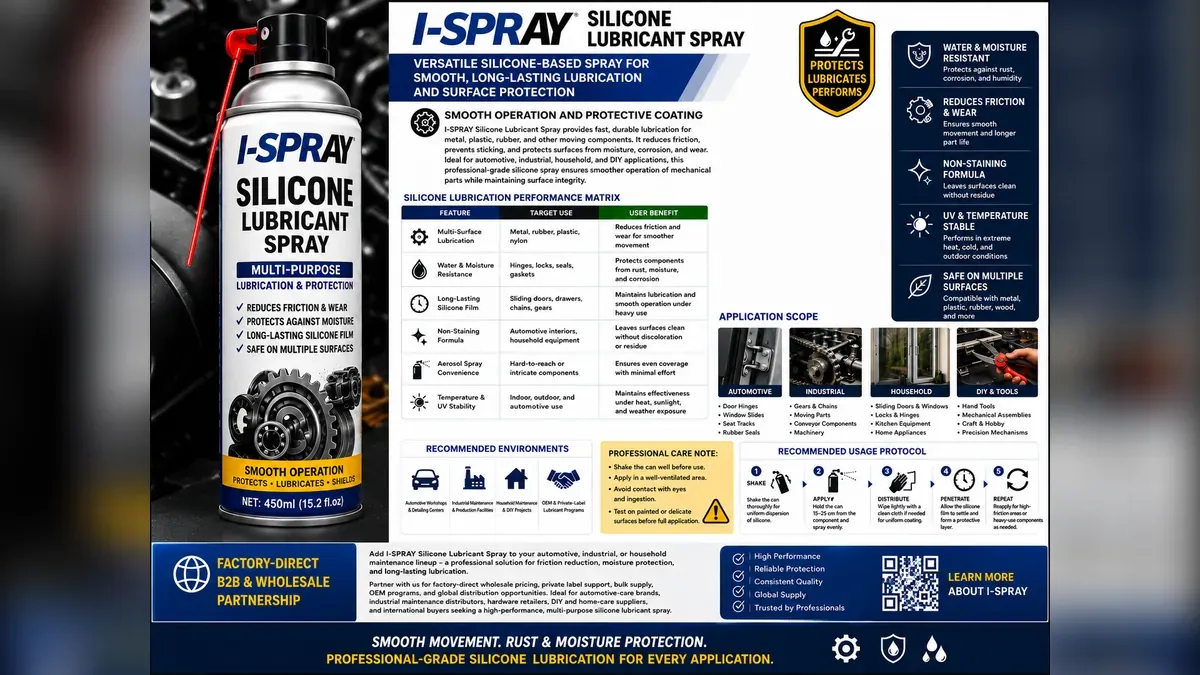
Huajie Chemical lists two relevant products in its textile range. I-SPRAY Silicone Lubricant Spray is a general multi-surface lubricant for metal, rubber, plastic, and nylon. JJW-F16 Super Silicone Spray is presented more specifically for sewing stations, cutting equipment, threads, guide tracks, and industrial moving parts.
The right choice depends on the lubrication point and the risk of silicone reaching the textile.
Start with the machine manual
Before spraying anything, check the equipment maker’s lubrication chart and maintenance instructions. Some points require a specified sewing-machine oil, grease, or dry lubricant rather than silicone. Other assemblies may be sealed and should not be sprayed at all.
Identify the material at the target point, its speed and temperature, the original lubricant, and its proximity to fabric, thread, sensors, electrical contacts, belts, and painted surfaces. If the manual prohibits silicone or does not permit field application, do not treat the point based only on a general product description.
This step also prevents a common purchasing mistake: ordering one multipurpose can for every squeak on the production floor.
Where I-SPRAY Silicone Lubricant Spray fits
The I-SPRAY product page lists metal, rubber, plastic, and nylon surfaces and applications such as gears, chains, sliding parts, seals, tracks, locks, and other moving components. It describes a silicone film intended to reduce friction, resist moisture, and protect compatible surfaces.
For a garment facility, that makes it a candidate for general maintenance points that the equipment manual allows and that can be isolated from fabric. The published directions call for shaking the can, spraying from 15 to 25 cm, and wiping lightly when an even coating is needed.
Test painted, delicate, or unfamiliar materials first. Also confirm whether the stated non-staining performance applies to the actual textile or surface near the maintenance point; do not infer fabric compatibility from general surface language.
Where JJW-F16 is the more direct textile option
JJW-F16 is positioned for high-speed cutters, sewing tracks, shuttle and needle-bar areas, passing threads, guide tracks, slides, and industrial moving parts. Its page describes a clear, fast-drying silicone layer and lists friction reduction, moisture displacement, thread sliding, rust prevention, and anti-stick use among its functions.
That textile-specific positioning makes JJW-F16 the more relevant product to test when thread drag, cutter drag, or material adhesion is the defined problem. It still needs machine approval and a controlled trial. A spray that helps one guide or cutter can be unsuitable at a point where mist might transfer to an unfinished fabric, interfere with bonding, or affect later printing and finishing.
Avoid assuming that a “six-in-one” product should replace every specialist cleaner and lubricant. Use only the function that has been validated for the target assembly.
Control silicone around fabric and finishing operations
Silicone contamination can be difficult to see at the maintenance station and become apparent later in coating, printing, bonding, dyeing, or quality inspection. Set boundaries around the spray area.
A sensible procedure includes:
- stopping and isolating the equipment as required by its manual;
- removing or shielding fabric, thread, and finished goods;
- using the minimum approved amount;
- allowing the carrier to dry before production resumes;
- wiping excess from exposed surfaces;
- running sacrificial material before releasing the machine;
- checking downstream bonding, printing, or finishing where relevant.
Do not spray near an operating needle, blade, drive, hot surface, or energized electrical assembly unless a documented procedure specifically permits it.
Design a maintenance trial
Choose one machine with a repeatable problem and establish a baseline. Record noise, temperature if normally monitored, drag, thread break frequency, cutter performance, cleaning frequency, and rejected pieces before treatment.
After applying the candidate according to the approved method, watch the same measures over a defined production period. Inspect sacrificial and finished fabric for spots, changes in hand feel, or later process problems. Keep the untreated or current-lubricant machine as a reference if the line setup allows it.
The trial should answer two questions: Did the treatment solve the maintenance problem, and did it introduce any textile or process defect?
General silicone spray versus sewing-focused spray
Choose by application rather than by the number of claims on the can.
Buying question | I-SPRAY Silicone Lubricant Spray | JJW-F16 Super Silicone Spray |
|---|---|---|
Published scope | General metal, rubber, plastic, nylon, tracks, gears, seals, and moving parts | Sewing stations, thread paths, cutters, tracks, slides, and plant components |
Published application style | Spray from 15–25 cm and distribute as needed | Direct light layer with rapid drying described on the product page |
Best reason to test | General compatible maintenance point | Defined textile-line friction, thread, cutter, or anti-stick problem |
Main approval concern | Material and machine compatibility | Fabric transfer and downstream process compatibility |
Specifications should confirm any technical difference that matters to the buyer. Website positioning alone does not establish viscosity, silicone concentration, temperature range, or dielectric performance.
B2B sourcing checklist
Ask for the current safety data sheet, product specification, application instructions, can size, valve and actuator details, transport information, minimum order quantity, and lead time. For private-label supply, agree on the exact approved claims and warnings.
Spray pattern is part of the product. A broad mist and a concentrated jet create different overspray risks, even with the same formula. Approve the complete can and actuator combination, then use a retained sample for later batch checks.
Practical recommendation
Use I-SPRAY Silicone Lubricant Spray as the starting candidate for general, compatible moving surfaces away from textile exposure. Test JJW-F16 when the problem is specific to sewing, cutting, thread movement, or an anti-stick task described for the textile line. In both cases, the machine manual and contamination trial take priority.
To discuss samples, contact Huajie Chemical with the machine type, lubrication point, materials, operating conditions, current product, problem description, and expected order volume.
FAQ
Can silicone spray replace sewing-machine oil?
Only if the machine manufacturer and the product instructions permit it for that specific point. Many machines require a defined oil or grease.
Is silicone spray safe near fabric?
It should be treated as a contamination risk until the complete process is tested. Shield materials, control overspray, wipe excess, and inspect downstream finishing or bonding.
What is the difference between I-SPRAY Silicone Spray and JJW-F16?
I-SPRAY is presented as a general multi-surface lubricant. JJW-F16 is positioned more directly for sewing stations, cutters, threads, tracks, and textile production equipment.
How far away should I hold the can?
The I-SPRAY page states 15 to 25 cm. Use the current label for the supplied product and a factory-approved method.
What should a maintenance trial measure?
Measure the original fault, machine behavior after treatment, reapplication interval, operator time, and any spots or downstream process defects on the textile.