Jul 28, 2026Buying Guides
Precision Contact Cleaner: Electronics Maintenance Guide
Evaluate precision contact cleaner for circuit boards, switches, relays, terminals, and sensors by soil, compatibility, drying, residue, and access.
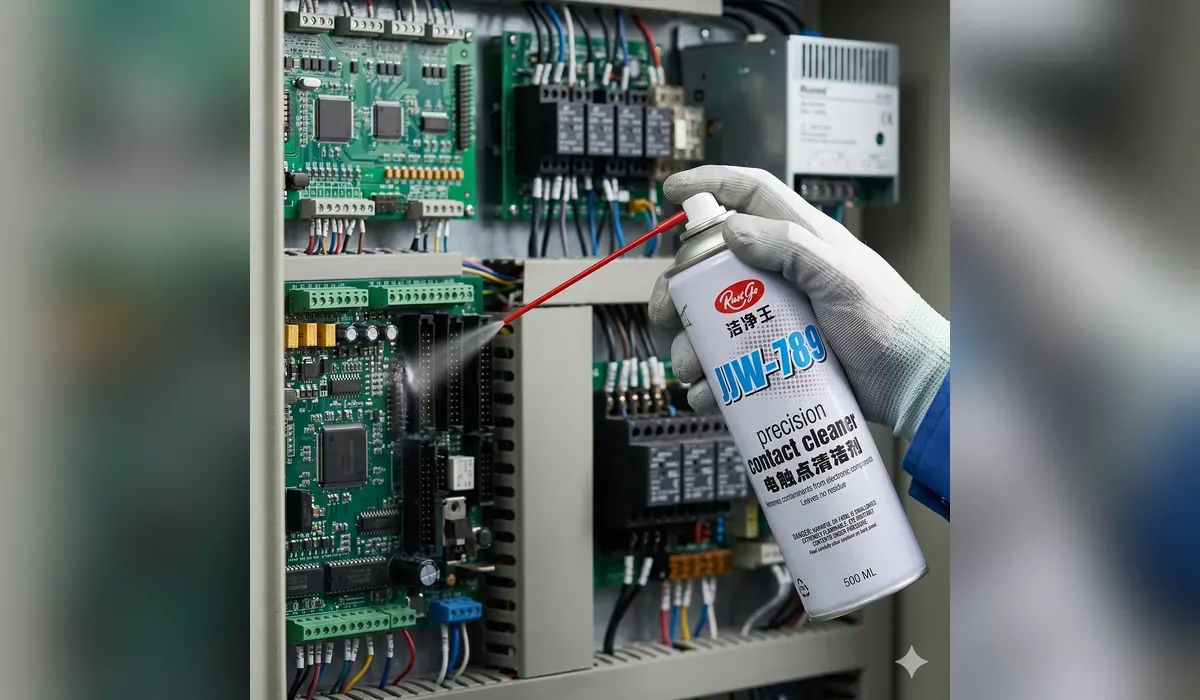
A precision contact cleaner is selected to remove suitable dirt and contaminants from electronic or electrical components while meeting the equipment’s requirements for drying, residue, material compatibility, and access. The safest sourcing approach begins with the component, contaminant, and maintenance procedure.
JJW-789 is described in Huajie’s product material as a fast-drying, residue-free cleaner for circuit boards, switches, relays, terminals, and sensors. The same material mentions an extension tube for targeted access. These points should still be validated on the exact materials and soils in the buyer’s application.
Define the cleaning task
- component or assembly;
- equipment state and approved maintenance procedure;
- dust, oil, flux residue, oxidation-related contamination, or another soil;
- plastic, elastomer, coating, label, adhesive, and metal materials nearby;
- access around terminals or housings;
- acceptable drying and return-to-service time;
- residue or cleanliness requirement;
- ventilation and ignition controls;
- manual wiping, brushing, or spray-only method;
- frequency and quantity of use.
“Electronics cleaner” is too broad. A cleaner that removes light oil from a terminal may not remove every flux, adhesive, carbon deposit, or conformal coating.
Start with the equipment instructions
Power down, isolate, discharge, and verify the equipment according to the maker’s procedure and the workplace’s lockout rules. Do not spray energized equipment merely because a product dries quickly.
Some assemblies contain stored energy, sensitive optical parts, displays, coated boards, plastics, seals, or lubricated mechanisms. Check the maintenance manual and component restrictions before introducing any solvent cleaner.
Match the product to the contaminant
Cleaning performance should be tested on the actual soil. Prepare representative coupons or failed parts when possible.
Record:
- contaminant source and age;
- thickness or severity;
- prior cleaners or process residues;
- application amount and dwell time;
- need for brushing or wiping;
- number of cleaning cycles;
- remaining visible or measured contamination;
- effect on the component and surrounding materials.
A dramatic spray-off demonstration can move contamination rather than remove it. Inspect where dissolved soil drains and whether it redeposits.
Use a controlled comparison
Compare the candidate with the current process and an untreated control. Use equivalent parts, the same soil, and the same application method.
Useful outcomes include cleaning time, amount used, access to recesses, drying time, residue, rework, and technician feedback. Where cleanliness is critical, use the site’s approved inspection or measurement method rather than visual judgment alone.
Test material compatibility
The product material describes JJW-789 as suitable for plastics and delicate components, but “plastic” covers many polymers, additives, stresses, colors, and finishes. Verify the exact grades in the assembly.
Check for:
- whitening, haze, discoloration, or gloss change;
- cracking or stress cracking;
- swelling, softening, or tackiness;
- label or print removal;
- adhesive weakening;
- coating damage;
- seal or elastomer change;
- loss of required lubricant.
Test both immediate appearance and delayed change after drying. A small hidden-area test can be useful, but representative coupons provide better control for purchasing approval.
Residue-free needs a defined test
“Residue-free” should mean the cleaner does not leave an unacceptable film under the buyer’s inspection conditions. It does not mean that dissolved contamination disappears regardless of application.
Use clean test surfaces and inspect after the stated drying period. If electrical performance matters, use an appropriate approved method. Do not turn a general description into an unsupported claim about every circuit or frequency.
Evaluate drying and return to service
Fast evaporation can reduce maintenance time, but drying depends on amount, geometry, temperature, ventilation, and trapped spaces.
Distinguish:
- surface visibly dry;
- concealed areas dry;
- no remaining odor or solvent pocket under the approved method;
- component ready for reassembly;
- equipment cleared for return to service.
Only the responsible maintenance procedure should authorize re-energizing. Waiting a generic number of minutes without considering recesses or ventilation is not a reliable rule.
Check targeted delivery
JJW-789’s extension tube is relevant where the cleaner must reach a switch, relay, terminal, or sensor area without flooding the assembly.
During sample review, assess:
- tube fit and retention;
- jet accuracy;
- control in short bursts;
- valve leakage;
- overspray;
- ability to reach the component;
- clogging after intermittent use;
- cap and tube storage;
- spray consistency as the can is used.
More force is not always better. A strong jet can move loose debris into another part of the assembly. The technician should use the least amount that achieves the validated cleaning result.
Separate contact cleaning from other maintenance sprays
Do not substitute a bolt loosener, spray grease, anti-static treatment, or multipurpose lubricant for a contact cleaner. Those products may leave functional films that are unsuitable for contacts or assemblies.
Likewise, contact cleaner should not be marketed as a lubricant unless the exact product is designed and documented for that role. Clear positioning reduces misuse in distributor catalogs.
Documentation and safety review
Before approval, request:
- current safety data sheet;
- product specification;
- application instructions and exclusions;
- material-compatibility information;
- drying and ventilation guidance;
- storage and transport classification;
- batch coding and traceability;
- any cleanliness or residue method used for claims.
Review flammability, ventilation, PPE, ignition control, waste handling, and storage under the site’s risk assessment. A “precision” label does not remove normal aerosol and solvent hazards.
Private-label procurement checklist
Confirm the approved formula and package:
- target components and soils;
- accepted compatibility and residue criteria;
- can size and fill quantity;
- valve, actuator, extension tube, cap, and carton;
- label directions, warnings, languages, and market responsibility;
- sample and pilot process;
- leakage, spray-output, filling, and appearance checks;
- batch traceability and retention;
- complaint investigation and change control;
- MOQ, lead time, and reorder component availability.
If the actuator or extension tube changes, repeat access and spray-control checks. Package hardware is part of performance.
Final recommendation
Select a precision contact cleaner through controlled testing on the actual contaminant and materials. Verify cleaning result, delayed compatibility, drying in concealed areas, residue, directional control, documents, and supply consistency before approving the SKU.
To discuss JJW-789 samples or a private-label package, contact Huajie Chemical with the components, soils, maintenance method, market, and expected volume.
FAQ
What components is JJW-789 intended to clean?
Huajie’s product material lists circuit boards, switches, relays, terminals, and sensors. Buyers should still confirm the exact component materials and equipment instructions.
Can contact cleaner be sprayed on energized equipment?
Do not assume so. Follow the equipment maker’s procedure, isolate and verify the equipment, review the product instructions, and apply the workplace risk controls.
Does fast drying mean the equipment can be powered immediately?
No. Solvent can remain in recesses or enclosed spaces. Return to service must follow the validated maintenance procedure and account for application amount, geometry, and ventilation.
How do I test plastic compatibility?
Use the actual plastic grade or a representative part, apply the intended amount, and inspect immediate and delayed effects such as haze, cracking, softening, print damage, or adhesive change.
Why is an extension tube useful?
It can direct cleaner into restricted areas and reduce unnecessary overspray. Buyers should test tube fit, jet accuracy, control, leakage, and access on real components.