Jul 28, 2026Buying Guides
Galvanizing Spray for Metal Repair: B2B Selection Guide
Learn how to source galvanizing spray for weld seams, cut edges, steel repairs, and maintenance programs using practical B2B evaluation criteria.
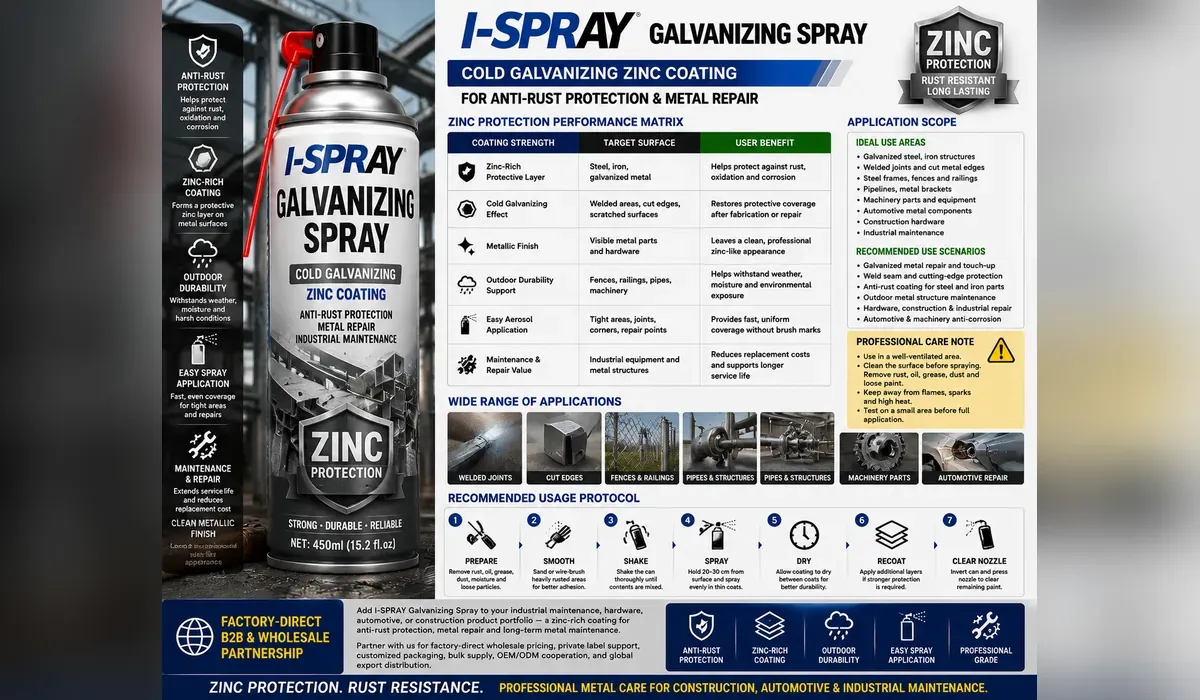
Galvanizing spray is most useful when a buyer has a defined metal-repair job: protecting a weld seam, touching up a cut edge, or restoring coverage on a steel or iron part after fabrication. It should not be purchased as a generic silver paint. The coating, surface preparation, application method, finish, and supporting documents must fit the actual maintenance process.
For distributors and industrial buyers, the practical question is not whether a can says “galvanizing.” It is whether the complete product can be tested and supplied consistently for the intended repair.
Where galvanizing spray fits in a maintenance range
I-SPRAY Galvanizing Spray is positioned for metal touch-up and repair. Relevant jobs include weld seams, cut edges, steel and iron components, hardware, machinery, outdoor structures, construction work, and automotive repair.
These jobs share one feature: fabrication or service work has left a small area needing renewed coverage. Aerosol application can be convenient for localized work and irregular shapes where a larger coating system would be inefficient.
That does not make every repair identical. A recently welded bracket, a cut galvanized panel, and weathered outdoor equipment can require different preparation and finishing steps. Buyers should define the job before requesting samples.
Galvanizing spray is not a substitute for every coating
The word “galvanizing” can refer to different processes and products. An aerosol repair coating is not the same process as hot-dip galvanizing. It should be evaluated as part of the repair system described by its manufacturer.
Do not assume that silver appearance proves protection, that one coat suits every exposure, or that a laboratory claim automatically predicts field life. Ask what was tested, how the panel was prepared, what film was applied, and which exact product the report covers.
Start with the metal and repair condition
A useful sourcing brief identifies:
- the base metal, such as steel or iron;
- whether the original surface is bare, painted, or galvanized;
- the type of damage, including cutting, welding, abrasion, or weathering;
- the size and geometry of the repair;
- indoor or outdoor use;
- likely exposure to water, humidity, salt, abrasion, heat, or chemicals;
- the required color and finish;
- whether another coating will be applied over the repair;
- the available cleaning, drying, and handling time.
This information helps a supplier recommend a relevant sample. Without it, two teams can use the phrase “metal repair” while describing very different conditions.
Separate new fabrication from maintenance repair
New fabrication usually offers more control over cleaning and timing. Maintenance work may involve old paint, corrosion, oil, inaccessible edges, and pressure to return equipment to service.
If both channels matter, test both. A coating that looks even on a prepared test panel may be harder to apply around bolts, corners, or vertical welds. The actuator and spray pattern become part of the evaluation.
Surface preparation determines what the test means
Coating comparisons are unreliable when preparation changes from sample to sample. Record the cleaning method, rust-removal method, abrasion, dust removal, and drying conditions used for each panel.
At minimum, the test surface should be clean, dry, and prepared according to the product instructions. Oil, loose corrosion, welding residue, and poorly bonded old paint can interfere with the repair. If the supplier recommends a specific preparation process, include it in the sample protocol rather than improvising after the test begins.
Use representative panels and real parts
Flat panels are useful for comparing appearance, coverage, and drying behavior. Real parts reveal access problems, overspray, runs, and difficulty covering edges or recesses.
A practical trial can include:
- a prepared flat panel for side-by-side comparison;
- a welded or cut sample that represents production work;
- a vertical or irregular part to check application control;
- a repeat application after the can has been stored and reused.
Record the distance, number of passes, interval between coats, ambient conditions, and time before handling. The goal is repeatability, not an impressive one-off demonstration.
What to inspect during sample approval
Buyers should evaluate the coating and the aerosol package together.
Application control
Check whether the spray reaches the target without excessive mist or waste. Observe fan width, discharge consistency, clogging, valve leakage, and how easily an operator can control coverage on a narrow weld seam.
Film and appearance
Review coverage, uniformity, visible defects, edge coverage, runs, and the final appearance after the stated drying period. If the repair must match surrounding metal or accept a topcoat, include that step in the test.
Adhesion and handling
Use the relevant internal or recognized test method rather than relying on a fingernail check. Confirm when the part can be touched, assembled, packed, or returned to service. “Dry” can describe several stages, so ask the supplier which stage a stated time refers to.
Evidence for corrosion claims
When a claim matters to the buying decision, request a report tied to the exact SKU and test conditions. Review surface preparation, film build, curing, exposure method, duration, and acceptance criteria. Avoid converting a test result into an unsupported service-life promise.
Compare galvanizing spray with adjacent products
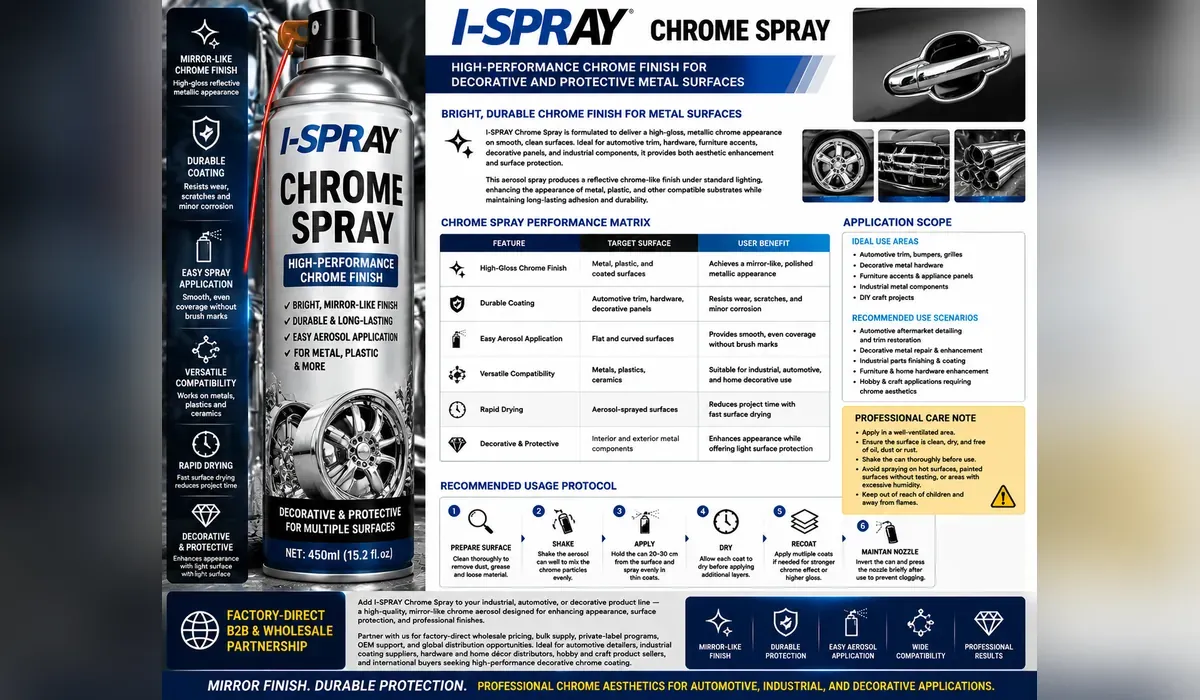
Range planning is clearer when each coating has a defined job. Galvanizing spray addresses localized metal coverage and repair. A chassis armor spray is selected for vehicle underbody protection, while a chrome spray is chosen mainly for a decorative metallic appearance.
These products should not share the same sales copy. The substrate, film, appearance, exposure, and validation method differ. Huajie’s industrial maintenance aerosol guide provides a broader framework for separating protective coatings, lubricants, cleaners, and repair products.
Supplier questions for distributors and private-label buyers
Before discussing artwork, ask for the technical and operational information needed to approve the product:
- product specification and current safety data sheet;
- approved substrates and stated exclusions;
- surface-preparation and application instructions;
- drying, recoating, and handling guidance;
- available test reports and the exact SKU they cover;
- can size, fill quantity, valve, actuator, cap, and carton options;
- batch coding and traceability process;
- leakage, spray-output, appearance, and filling checks;
- label information required for the destination market;
- sample, pilot, artwork, and change-control process.
MOQ, lead time, and packaging can then be discussed against a defined configuration. A price comparison made before the specification is aligned can compare unlike products.
Build a useful request for quotation
Send the supplier a short application brief with photos if possible. Include the metal, repair type, exposure, desired finish, estimated volume, destination market, sales channel, can preference, label language, and current product or problem.
Ask for a sample plan that reflects the intended workflow. If several use cases are important, identify the priority instead of asking one can to solve every corrosion and coating job.
Final recommendation
Choose galvanizing spray as a complete repair system, not by color or a broad anti-rust claim. Define the metal and exposure, standardize surface preparation, test the film on representative parts, and verify any performance evidence before commercial approval.
For a sample and packaging discussion, contact Huajie Chemical with your application, destination market, expected order volume, and private-label requirements.
FAQ
What is galvanizing spray used for?
It is commonly considered for localized metal touch-up and repair, including weld seams, cut edges, steel and iron parts, machinery, hardware, outdoor structures, construction work, and automotive repair.
Is galvanizing spray the same as hot-dip galvanizing?
No. An aerosol repair coating and hot-dip galvanizing are different processes. Evaluate the aerosol according to its stated coating system, instructions, and supporting test evidence.
What should be included in a galvanizing spray test?
Use controlled surface preparation, representative panels and parts, recorded application conditions, film and appearance checks, handling evaluation, and any performance method relevant to the intended exposure.
Can galvanizing spray be painted over?
Do not assume universal topcoat compatibility. Ask for the product instructions and test the intended topcoat, application interval, adhesion, and appearance as a complete system.
What should a private-label buyer confirm?
Confirm the formula specification, substrates, instructions, documentation, package components, label requirements, quality checks, samples, batch traceability, MOQ, and lead time for the agreed configuration.