Jul 28, 2026Buying Guides
Car Air Conditioner Cleaner: Foam Cleaning Buyer Guide
A B2B guide to car air conditioner cleaner covering accessible components, foam behavior, moisture, compatibility, instructions, and sample tests.
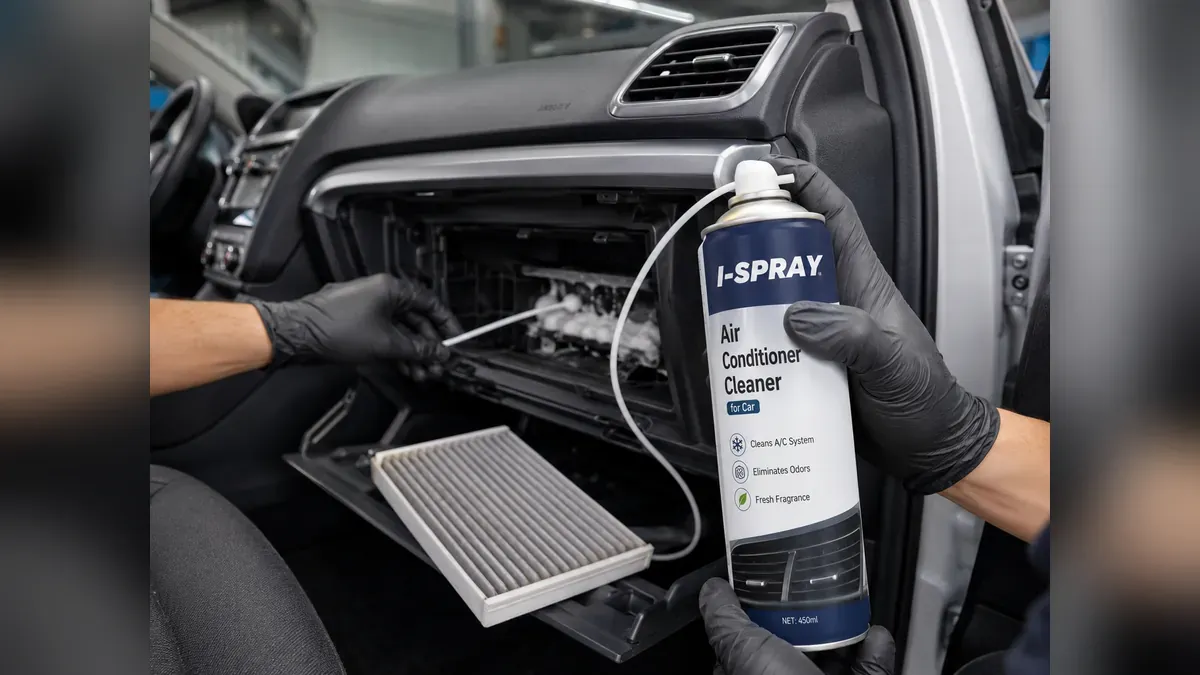
A car air conditioner cleaner is used on approved, accessible air-path components. It is not refrigerant, does not diagnose a cooling-system fault, and should not be presented as a repair for every odor or airflow problem.
Buyers need to define where the foam goes, how contamination is removed, how moisture is managed, which electrical or sensitive components are excluded, and what the user does before restarting the system.
This guide explains how distributors and private-label brands can evaluate an automotive A/C foam cleaner before ordering.
Define the cleaning scope
Huajie's I-SPRAY Air Conditioner Cleaner for Car is positioned for no-disassembly foam cleaning of automotive air ducts, fans, and heat exchangers.
"No disassembly" should not be read as "no inspection." Vehicle HVAC layouts vary, and not every component is safely accessible from the same point. The final instructions must match the approved application locations for the target vehicles.
The product should also avoid diagnosing the cause of odor. Odor may relate to dirt, moisture, drainage, filters, outside contamination, or another vehicle issue. Cleaning is one maintenance action, not proof that the HVAC system has no fault.
Keep cleaning and refrigerant service separate
I-SPRAY Automotive A/C Refrigerant / Snow Gas belongs to refrigerant-system service. A/C foam cleaner belongs to accessible air-path cleaning.
Weak cooling does not automatically call for cleaner, and odor does not automatically call for refrigerant. Distributors should train staff to ask whether the customer has a cleanliness issue, an airflow issue, or a cooling-system issue.
Separate product pages and packaging reduce cross-use and create clearer search intent.
Foam behavior inside an air path
Foam needs to reach the approved surface and then collapse or drain according to the product procedure. More expansion is not always better.
During sample testing, observe:
- foam expansion and coverage;
- cling on vertical or angled surfaces;
- collapse and drainage;
- liquid volume after collapse;
- residue on the treated surface;
- odor during and after treatment;
- extension-tube control;
- leakage at the valve or tube connection.
Use a representative duct or component rig where possible. An open-panel foam demonstration does not show how the product behaves inside a confined passage.
Moisture and drainage require attention
An A/C cleaning process can introduce liquid into an area that may contain drains, fans, connectors, sensors, filters, and electronics. The instructions should tell the user where the product can be applied and how the vehicle should be prepared.
Buyers should confirm:
- whether the cabin filter is removed, protected, or replaced;
- which fan and electrical components must be isolated;
- how drains are checked;
- where runoff should exit;
- what surfaces below the vehicle or dashboard need protection;
- how long the system remains off;
- what ventilation step follows cleaning.
Do not write a universal procedure from a single vehicle. The supplied label may need a general safe scope plus a recommendation to follow vehicle-specific service information.
Material compatibility
Automotive HVAC areas can contain plastics, foams, adhesives, coated metals, rubber seals, filters, wiring, and electronic parts. Ask for the approved material list and exclusions.
Test representative materials at the stated contact and drainage conditions. Look for swelling, softening, staining, adhesive failure, residue, or odor retention.
If the product will be used by consumers, accidental overspray and incorrect tube placement become more likely. The instructions and application diagram should address those risks directly.
Cleaning and odor claims
Avoid unsupported claims such as "sterilizes," "kills all bacteria," or "removes every odor." Such statements may require specific testing, regulatory status, and label language in the destination market.
A clear cleaning claim is more useful when it states the approved components and procedure. If antimicrobial or disinfectant claims are proposed, confirm that they apply to the exact supplied product and market before artwork is printed.
Do not use fragrance strength as proof of cleaning. A strong scent can mask residual odor during a short sample review.
A buyer sample test
Create a written test using representative HVAC components or a controlled rig.
- Define the duct, fan, heat-exchanger, or other approved component.
- Record the material and starting contamination.
- Apply a measured amount through the supplied tube or actuator.
- Observe expansion, contact, collapse, drainage, and runoff.
- Follow the stated waiting and ventilation procedure.
- Inspect remaining dirt, residue, material condition, and odor.
- Check tube retention, valve performance, and can leakage.
- Repeat with several cans and, where practical, several vehicle layouts.
Photograph tube placement and drainage. These details are useful when reviewing instructions and customer questions.
Packaging and instruction design
The extension tube is a functional component. Check its length, flexibility, fit, storage, and resistance to detaching during application.
The label should present preparation and exclusions before the user begins spraying. Vehicle shutdown, filter handling, tube placement, application amount, waiting, drainage, restart, and ventilation should appear in a logical sequence.
For private-label supply, test the final actuator and tube rather than approving only the bulk formula. A small hardware change can alter foam delivery and placement.
Questions to ask the supplier
Ask for written answers:
- Which HVAC components and vehicle applications are approved?
- Where should the product be introduced into the air path?
- Which filters, electronics, sensors, and materials must be protected?
- How should foam collapse, runoff, and drainage be managed?
- What cleaning or odor tests support the proposed claims?
- What waiting, restart, and ventilation instructions apply?
- How are fill weight, foam output, tube fit, valve function, and leakage checked?
- Which documents and private-label package options are available?
An undefined application point is a reason to stop approval and request clearer instructions.
Final recommendation
Choose car air conditioner cleaner by the approved component and procedure. Test foam delivery inside a representative air path, confirm drainage and material compatibility, and keep cleaning claims separate from refrigerant service or unverified disinfection claims.
To discuss samples or private-label A/C cleaning products, contact Huajie Chemical with the target vehicles, application point, cleaning scope, market, package preference, and documentation needs.
FAQ
Is car A/C cleaner the same as refrigerant?
No. Cleaner is used on approved accessible air-path components. Refrigerant belongs to the sealed cooling system and must match the system specification.
Does no-disassembly cleaning work on every vehicle?
Do not assume it does. HVAC layouts and access points vary. Follow the product instructions and vehicle-specific service guidance.
Should the cabin filter be removed?
The correct step depends on the product and vehicle procedure. The final instructions should state how the filter is handled and when it should be inspected or replaced.
Can A/C foam cleaner claim to disinfect?
Only if that claim is supported for the exact product and allowed in the destination market. Do not add antimicrobial or sterilization wording without the required evidence.
What should distributors test?
Test foam placement, expansion, collapse, drainage, residue, odor, material compatibility, tube fit, valve performance, leakage, and the clarity of the instructions.