Jul 28, 2026Buying Guides
Bolt Loosener Spray: Seized Fastener Maintenance Guide
Evaluate bolt loosener spray for seized fasteners by penetration, application access, residue, compatibility, packaging, and supplier documentation.
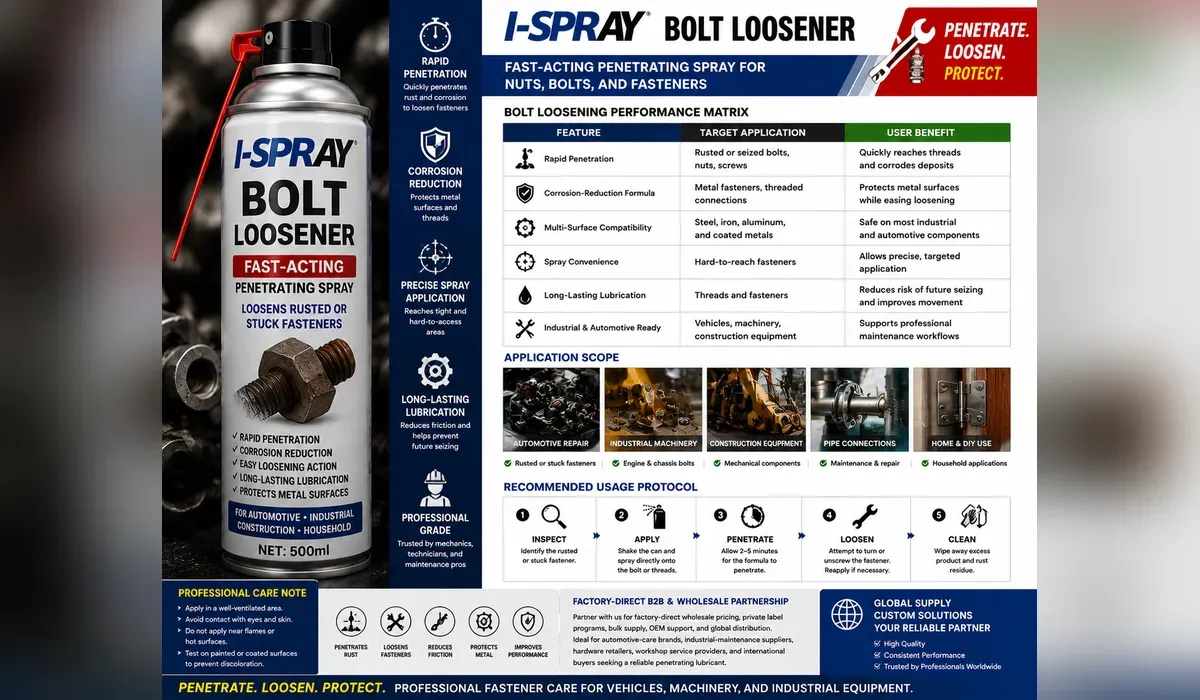
Bolt loosener spray is selected for access and penetration around seized or difficult fasteners. A sound B2B evaluation should reproduce the real maintenance problem, measure the technician’s working time and result, and check what remains on the component after use.
Do not choose it simply because a demonstration bolt turns. Fastener condition, corrosion, access, dwell time, tools, temperature, and prior treatment can change the outcome. Buyers need a repeatable trial and a clear distinction between a penetrant, a general maintenance fluid, and a longer-lasting lubricant.
Define the fastener problem first
I-SPRAY Bolt Loosener belongs in the loosen-and-lubricate part of an industrial maintenance range. Its selection starts with a concrete job rather than the broad phrase “rusty bolt.”
Describe:
- fastener type, size, and orientation;
- component and surrounding materials;
- visible corrosion, contamination, old lubricant, or coating;
- indoor, outdoor, workshop, marine, or plant environment;
- access around the thread and head;
- whether heat or impact tools are allowed;
- available dwell time;
- downstream cleaning, painting, assembly, or inspection;
- operator concerns about overspray, odor, dripping, and residue.
A product for a workshop bench may not be the best package for a recessed fastener above an operating line. The formula and delivery system must be considered together.
Diagnose before applying more force
A fastener can resist removal because of corrosion, thread damage, deformation, a locking compound, contamination, or incorrect installation. A penetrant cannot correct every cause.
Maintenance teams should inspect the joint, identify safety risks, and follow the equipment procedure. Spraying an unknown chemical near energized equipment, hot surfaces, ignition sources, brakes, or sensitive materials can create new problems. Product instructions and the workplace risk assessment control the method.
Penetrant, lubricant, and multipurpose spray are not identical
Buyers often group several aerosols under “anti-rust oil.” That makes catalogs confusing and trials inconclusive.
Bolt loosener or penetrant
The priority is reaching the restricted space around a seized thread and supporting removal within the maintenance window. Access, wetting, dwell time, and controlled delivery matter.
Spray grease
I-SPRAY Aerosol Lubricant / Spray Grease is better framed around leaving a more persistent lubricating film on machinery points where that film is appropriate. A heavier remaining layer may be useful for one job and undesirable for another.
Multipurpose anti-rust lubricant
JJW-854 RD-40 is an adjacent multipurpose maintenance product. A buyer may compare it when moisture displacement, light lubrication, freeing action, or corrosion protection is part of the brief. It should not be presented as automatically interchangeable with a focused bolt loosener.
The industrial maintenance aerosol selection guide explains how to separate these product roles before range approval.
Design a repeatable seized-fastener trial
Random workshop anecdotes do not provide a fair comparison. Build a small protocol using actual parts or a controlled set of representative fasteners.
Group fasteners by condition
Do not mix lightly weathered bolts with severely corroded assemblies and report one average. Record material, size, exposure history, corrosion condition, orientation, and any prior treatment. Where controlled test pieces are used, prepare them in the same way.
Standardize application
For each sample, record:
- whether loose dirt was brushed away;
- application distance and duration;
- use of an extension tube;
- dwell time;
- tool and leverage;
- whether a second application was allowed;
- removal result and technician observations;
- residue and cleanup after the task.
If torque measurement is appropriate, use the same calibrated method and fixture. If the real job is field maintenance, also record access time, mess, and total labor. A product that performs well in a fixture but is difficult to direct may not reduce downtime.
Include an untreated control
Where it is safe and practical, include a comparable untreated fastener or the current product. The control helps separate product effect from variation in the fasteners or tools.
Check the actuator and extension tube
Seized threads are often partly hidden. An extension tube can help direct the spray and reduce contamination of nearby parts. During sample review, check:
- how securely the tube fits;
- whether the jet reaches the intended gap;
- control at short bursts;
- leakage around the valve;
- overspray and dripping;
- clogging after the can is stored and reused;
- spray consistency through the usable life of the can;
- cap retention and storage of the tube.
Technicians may use the product while wearing suitable gloves. Make sure the package can be handled as intended under real workplace conditions.
Review residue and material compatibility
Penetration is only part of the job. Ask what remains after application and whether it affects:
- painted or coated surfaces;
- plastics and rubber near the fastener;
- electrical insulation or connectors;
- belts, brakes, friction surfaces, or sensors;
- dust-sensitive equipment;
- later thread-locking, painting, bonding, or inspection.
Compatibility statements should identify the tested material and conditions. When the consequence of damage is significant, test an inconspicuous or representative sample first and follow the equipment maker’s instructions.
Do not claim that one aerosol is “safe on all materials.” Industrial assemblies contain many grades and finishes, and prior cleaners or lubricants can influence the result.
Measure total maintenance value
Can price is easy to compare but rarely explains the full cost of a seized-fastener task. Useful measures include:
- time from inspection to removal;
- number of applications;
- quantity used;
- need for heat, cutting, or replacement parts;
- cleanup time;
- damaged fasteners or surrounding components;
- operator acceptance;
- waste from poor spray control.
A lower-priced can may cost more if the actuator wastes product or the team repeatedly reapplies it. A higher-priced product still needs evidence that it improves the defined process.
Documentation and safety review
Ask the supplier for the current safety data sheet, product specification, application instructions, substrate guidance, storage information, transport classification, batch coding, and any relevant test evidence.
Pressurized aerosols require suitable storage and handling. Workplace teams remain responsible for ventilation, ignition control, PPE, training, disposal, and their own risk assessment. Do not transfer a supplier document from one formula or destination market to another without checking its scope.
Private-label and distribution checklist
For a branded bolt loosener, align the product and package before approving artwork:
- intended fastener and maintenance applications;
- formula specification and accepted residue;
- can size and fill quantity;
- valve, actuator, extension tube, cap, and carton;
- label directions, warnings, and languages;
- sample and pilot approval process;
- spray-output, leakage, appearance, and fill checks;
- batch traceability and complaint investigation;
- component availability and reorder planning;
- agreed MOQ and lead time for the final configuration.
Avoid naming every penetrant a “multi-purpose lubricant.” Clear product roles help distributors train sales teams and reduce incorrect use.
Build a useful supplier brief
Send photos or a short video of the fastener location, along with the substrate, corrosion condition, access, dwell time, current product, destination market, expected annual volume, and packaging needs. State whether the priority is faster removal, better directional control, less residue, or a clearer private-label range.
Ask for samples only after the test method is agreed. That gives both parties a more useful result than a general can-to-can comparison.
Final recommendation
Select bolt loosener spray by penetration task, access, working time, residue, compatibility, and repeatable supply. Keep it distinct from spray grease and multipurpose maintenance fluids, then validate the complete aerosol package on representative fasteners.
To discuss a sample plan or private-label program, contact Huajie Chemical with your application, market, package preference, and estimated volume.
FAQ
What is bolt loosener spray used for?
It is used as a penetrating maintenance product around seized or difficult fasteners. The exact method depends on the fastener, corrosion, surrounding materials, workplace conditions, and product instructions.
How long should a bolt loosener be left to penetrate?
Use the dwell time stated for the product and validate it against the maintenance window. Do not invent one universal time for all formulas and corrosion conditions.
Is bolt loosener the same as spray grease?
No. A bolt loosener prioritizes access and penetration around difficult threads. Spray grease is generally selected when a more persistent lubricating film is required at an appropriate machinery point.
What should distributors test?
Test representative fasteners, directional control, extension-tube fit, dwell time, removal result, repeat application, residue, cleanup, compatibility, leakage, and spray consistency.
What information helps a supplier recommend a sample?
Provide the fastener and component, corrosion condition, access, environment, dwell time, restrictions, destination market, current product, volume, and private-label package needs.