Jul 28, 2026Buying Guides
Automotive A/C Refrigerant: Sourcing and Selection Guide
A sourcing guide for automotive A/C refrigerant covering system compatibility, market requirements, packaging, documentation, and supplier checks.
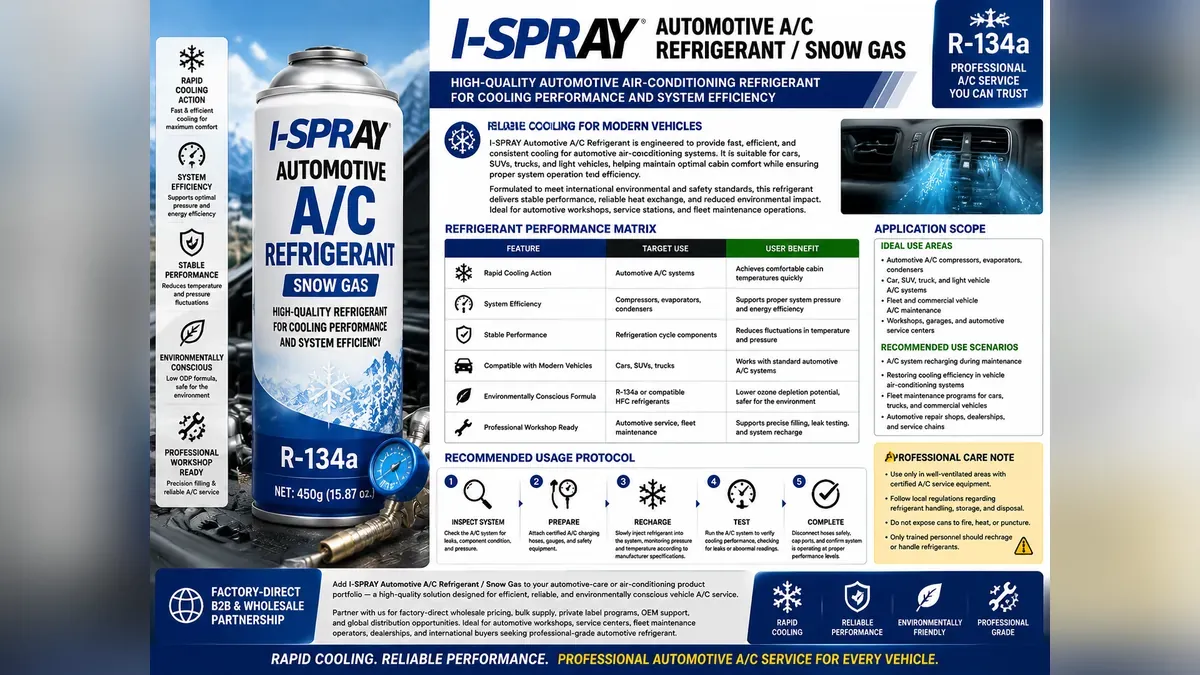
Automotive A/C refrigerant must be selected for a defined vehicle system and destination market. Similar-looking cans are not automatically interchangeable, and a generic promise of "colder air" is not enough for a responsible purchasing decision.
Importers and distributors should first identify the required refrigerant specification, service connection, can and valve configuration, label rules, transport requirements, and documentation. Only then does it make sense to compare price or packaging.
This guide focuses on the sourcing questions a B2B buyer should settle before approving an automotive refrigerant product.
Confirm the system before discussing the can
Huajie's I-SPRAY Automotive A/C Refrigerant / Snow Gas is presented as an automotive air-conditioning product for cooling performance and system efficiency.
The public product name does not replace a technical specification. Buyers must obtain written confirmation of the supplied refrigerant type and ensure that it matches the vehicles, service equipment, and legal requirements in the destination market.
Do not infer the formula from the can size, connector, trade name, color, or a photograph. These details may look familiar across products with different technical requirements.
Build a market and vehicle brief
Send the supplier a written brief that covers:
- destination country or region;
- target vehicle years and makes;
- refrigerant specification required by those systems;
- professional-service or consumer sales channel;
- preferred can size and valve arrangement;
- language and labeling requirements;
- expected order volume and packaging format;
- documents required by the importer, customs broker, and customers.
A distributor serving workshops may need a different package from a retail brand selling a small service can. The channel affects connector selection, instructions, warnings, and technical support.
Compatibility includes the service connection
Even when the refrigerant specification is correct, the package must work with the intended charging equipment. Check the can valve, thread or connection type, adapter requirements, hose, seal, and puncturing or self-sealing arrangement.
Test the complete system rather than reviewing the can separately. A mismatch can cause leakage, poor control, product loss, or unsafe handling.
Ask whether the connector is included, sold separately, or supplied by the local distributor. If several equipment standards exist in the market, define which one the product supports and state that clearly on the label.
Documentation is part of the product
Automotive refrigerant is a regulated and transported chemical product. The exact requirements depend on the formulation and destination market, so the importer should obtain current documents for the supplied item.
The review normally starts with:
- product specification;
- safety data sheet;
- transport classification and shipping information;
- label and warning text;
- batch identification and traceability details;
- packaging specification;
- any destination-market declarations that actually apply.
Do not copy a competitor's hazard text or environmental claims. Documentation and artwork must match the supplied formula.
If the supplier offers several refrigerant options, keep separate specifications, samples, labels, and approvals. Similar filenames and nearly identical artwork can create expensive ordering mistakes.
What to verify in a sample
Sample approval should cover more than cooling output.
Package and valve
Inspect the can, seam, valve, cap, printed information, batch code, and carton. Test connection to the intended service equipment and check for leakage before, during, and after use.
Identity and specification
Match the sample and documents to the required refrigerant specification. The buyer should use an appropriate verification method and qualified service partner. Do not rely on packaging color or supplier assurances given only in a chat.
Charging behavior
Use the product only within an approved service procedure. Record connection, flow control, can behavior, and any leakage. Vehicle A/C work should be carried out by trained personnel where required.
Storage and transport
Review how the cans are packed for export, warehousing, retail display, and local delivery. Consider the temperatures and handling conditions expected in the supply chain without inventing storage limits that are not in the approved documentation.
Avoid unsupported performance claims
Phrases such as "universal," "eco-friendly," "safe for every vehicle," or "maximum cooling" need evidence and may be inappropriate for the supplied product or market.
A useful product page can be precise without overpromising. It should state the confirmed refrigerant specification, compatible systems, package type, intended service channel, and document availability. It should also tell customers when professional installation is required.
Clear limitations build more trust than a long list of unverified benefits.
Pair refrigerant with A/C cleaning carefully
Refrigerant service and air-path cleaning address different problems. I-SPRAY Air Conditioner Cleaner for Car is positioned for no-disassembly foam cleaning of automotive air ducts, fans, and heat exchangers.
A cabin odor or dirty air path does not automatically mean the refrigerant charge is wrong. Weak cooling does not prove that cleaning alone will solve the issue. Distributors should keep these jobs separate in their product range and training.
This separation also produces clearer online content: one page covers refrigerant compatibility and sourcing; another covers accessible A/C cleaning applications.
Supplier questions before purchase
Ask for specific written answers:
- What exact refrigerant specification will be supplied?
- Which vehicle systems and service equipment is it intended for?
- What can, valve, connector, and adapter options are available?
- Which documents are supplied with each batch or product?
- How are fill weight, leakage, valve function, and batch identity checked?
- Which label claims are supported for the destination market?
- How are different refrigerant products separated in production and warehousing?
- What artwork, carton, language, and private-label options can be confirmed?
If the answer to the first question is not clear, stop the approval process. Packaging design cannot compensate for an undefined product specification.
Final recommendation
Buy automotive A/C refrigerant by specification, system, connection, market, and documentation. Confirm all five in writing and test the supplied package with the intended service equipment before placing a production order.
For a sourcing discussion, contact Huajie Chemical with the destination market, required refrigerant specification, target vehicle systems, service connection, can format, and document list.
FAQ
Are all automotive A/C refrigerants interchangeable?
No. Vehicle systems are designed for specified refrigerants and service procedures. Confirm the exact product and system requirement before use or purchase.
Can the refrigerant type be identified from the can?
Do not rely on can size, color, connector appearance, or trade name alone. Use the product specification, label, safety data sheet, and appropriate verification.
What should an importer request from the supplier?
Request the exact specification, safety data sheet, transport information, label copy, packaging details, batch-identification method, and any documents required for the target market.
Is an A/C cleaner the same as refrigerant?
No. An A/C cleaner addresses contamination in approved air-path components. Refrigerant belongs to the sealed cooling system and requires the correct service procedure.
Can private-label artwork be prepared before sample approval?
Initial design can begin, but final claims, warnings, specification, connection details, and instructions should not be printed until the supplied product and package have been approved.