Jul 28, 2026Buying Guides
Anti-Static Spray: Selection Guide for Industrial Buyers
Select industrial anti-static spray by defining the material, process, static problem, residue limits, compatibility tests, application method, and documents.
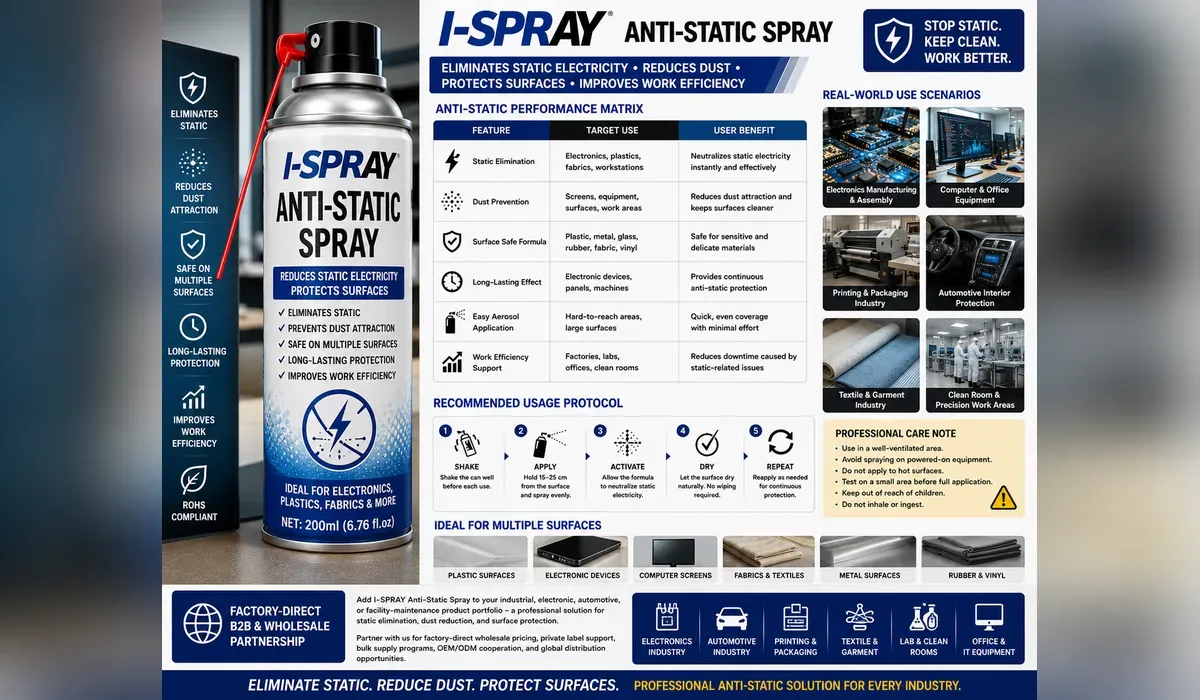
Industrial anti-static spray should be selected for a specific material and process problem. Static can attract dust, make films or textiles cling, disturb handling, or create discomfort, but the acceptable treatment depends on the substrate, environment, residue limit, downstream process, and workplace controls.
A buyer should not approve a product from a quick “no more static” demonstration. Define how static is observed or measured, then test application, persistence, compatibility, cleanliness, and repeatability under representative conditions.
Identify the real static problem
I-SPRAY Anti-Static Spray belongs in a process-support range, not as a universal treatment for every static-sensitive environment.
Prepare a brief covering:
- film, plastic, textile, carpet, packaging, equipment surface, or other material;
- dust attraction, cling, handling, winding, feeding, or operator discomfort;
- process speed and contact points;
- indoor temperature and humidity;
- cleanroom, electronics, printing, painting, bonding, or food-contact restrictions;
- acceptable wetness, odor, visible marks, and residue;
- frequency and method of reapplication;
- cleaning method before and after treatment;
- area size and preferred spray pattern.
Static changes with material, friction, humidity, and process conditions. A result obtained on a humid day may not represent a dry production shift.
Anti-static treatment is not electrical safety engineering
An anti-static surface spray should not be treated as a replacement for grounding, bonding, conductive equipment, humidity control, ESD procedures, hazardous-area controls, or specialist engineering.
If static presents a fire, explosion, electronic-component, or personnel hazard, the site must use an approved risk-control system. Confirm whether a spray is permitted in that system before testing it.
Define how success will be measured
The test can combine process observations and appropriate measurements. Useful outcomes may include:
- reduced dust attraction;
- smoother separation of film or sheets;
- less textile cling;
- fewer handling interruptions;
- improved feeding or winding;
- acceptable surface resistance or charge-decay result under a defined method;
- no visible residue or downstream defect.
If instruments are used, record the method, equipment, conditioning, humidity, temperature, electrode setup, and timing after application. Numbers from different methods are not automatically comparable.
Establish a baseline
Observe the untreated process first. Record the static symptom, defect rate, stoppages, dust level, and environmental conditions. A baseline helps determine whether the treatment changes the process or whether conditions changed on their own.
Use untreated and current-product controls where possible. Repeat the test across more than one shift or environmental condition if the problem is intermittent.
Test material compatibility
An anti-static treatment may leave a functional film. That film can be acceptable on one substrate but interfere with another process.
Test for:
- discoloration, staining, or gloss change;
- stress cracking or softening of plastics;
- texture or hand-feel change on textiles;
- attraction of dirt after treatment;
- effect on printing, coating, painting, lamination, sealing, or bonding;
- transfer to adjacent parts or packaging;
- cleaning and reapplication behavior.
Use the actual grades, colors, finishes, and additives found in production. “Plastic safe” is too broad because plastics and surface treatments differ.
Electronics require a separate decision
Do not spray energized equipment or electronic assemblies unless the exact product, method, and site procedure permit it. For cleaning electrical contacts, use a product designed and approved for that task, such as JJW-789 Precision Contact Cleaner, and follow the equipment and product instructions.
Anti-static surface treatment and contact cleaning solve different problems.
Evaluate application and coverage
The aerosol should place a controlled, even amount on the target. Too little may give inconsistent treatment; too much may create wet spots, residue, longer drying, and waste.
During sample approval, review:
- spray width and uniformity;
- atomization and visible droplets;
- coverage on vertical and horizontal surfaces;
- overspray into nearby production areas;
- nozzle clogging after pauses;
- can handling and directional control;
- drying or conditioning time;
- amount used per acceptable treated area.
If the operating method includes wiping or spreading, standardize the cloth, pressure, number of passes, and drying interval.
Determine persistence and reapplication
“Long lasting” has little value without a process definition. The treatment may be affected by abrasion, washing, handling, humidity, dust, heat, and the nature of the substrate.
Inspect or measure performance:
- after the stated application and drying period;
- after normal handling;
- after a defined production interval;
- after cleaning or abrasion where relevant;
- under the drier conditions that make the problem worse.
Set a practical reapplication trigger. It may be based on a measurement, a handling symptom, a production interval, or cleaning. Avoid promising a fixed duration outside the tested conditions.
Review worker and process controls
Request the current SDS and application instructions before a plant trial. Review ventilation, ignition sources, PPE, restricted areas, nearby materials, storage, and disposal.
An aerosol mist can travel outside the intended surface. Protect adjacent products, sensors, floors, and operations. Schedule treatment during a controlled maintenance or changeover window if overspray or drying could disrupt production.
The facility remains responsible for its risk assessment and ESD or hazardous-area program. Supplier information supports that work but does not replace it.
Supplier and private-label checklist
Ask for:
- product specification and intended substrates;
- application and exclusion guidance;
- available performance method and test conditions;
- SDS, storage, and transport information;
- residue and cleaning guidance;
- can size, fill quantity, valve, actuator, cap, and carton;
- sample and pilot approval procedure;
- leakage, spray-output, appearance, and filling checks;
- batch coding and traceability;
- label directions, warnings, and market languages;
- MOQ, lead time, and change-control process for the agreed product.
If an anti-static claim is central to the brand, agree on a release or monitoring method that the supplier can apply consistently. A vague claim is harder to investigate when a customer reports inconsistent results.
Position the product honestly
Present the spray for the materials and static symptoms supported by testing. Do not imply that it makes any area “ESD safe,” eliminates ignition risk, or protects sensitive electronics unless qualified evidence and the complete control system support that statement.
The broader industrial maintenance aerosol guide helps buyers separate process treatments from cleaners, lubricants, coatings, and repair products.
Final recommendation
Choose industrial anti-static spray by material, process outcome, residue tolerance, compatibility, application control, persistence, and documentation. Test under representative humidity and handling conditions, and keep the product within the facility’s existing safety and ESD controls.
To discuss samples or private label, contact Huajie Chemical with the substrate, process, static symptom, market, package needs, and estimated volume.
FAQ
What is industrial anti-static spray used for?
It may be considered where static contributes to dust attraction, cling, sheet separation, handling, feeding, or similar surface and process problems. Suitability depends on the material and environment.
Can anti-static spray replace grounding?
No. It should not replace grounding, bonding, ESD procedures, conductive equipment, hazardous-area controls, or specialist engineering.
How should buyers test anti-static performance?
Establish an untreated baseline, control temperature and humidity, use representative materials, define the observation or measurement method, and inspect residue and downstream compatibility.
How often should it be reapplied?
Set the interval from representative testing. Abrasion, washing, handling, humidity, dust, heat, and the substrate can change persistence.
What should private-label buyers verify?
Verify the intended substrates, performance method, residue, instructions, documents, package components, quality checks, traceability, label requirements, MOQ, and lead time.